InstagramFacebookLinkedinMediumYoutubeX
Oryon iq

8A Certification for Small Businesses: Your Complete Step-by-Step Guide to Federal Contracting Success

The 8a certification program represents one of the most valuable opportunities for small business owners seeking to break into the lucrative federal contracting marketplace. This comprehensive guide will walk you through everything you need to know about obtaining 8a certification from the SBA, from understanding eligibility criteria to navigating the application process and leveraging your certified status to win federal contracts. Whether you're a first-time applicant or looking to maximize the program benefits, this article provides actionable insights that can transform your business's access to government contracting opportunities worth billions of dollars annually.

What Is 8a Certification and Why Does It Matter for Small Businesses?

The 8a Business Development Program, administered by the Small Business Administration, is designed to help small disadvantaged businesses compete in the federal marketplace. This certification program provides participating firms with access to federal contracts through sole-source contracts and set-aside contracts that are specifically reserved for 8a-certified companies.

The certification helps small businesses owned by socially and economically disadvantaged individuals gain a foothold in government contracting. Federal agencies are mandated to award a percentage of their federal contracting dollars to small disadvantaged business participants, creating substantial contract opportunities. In 2023, federal agencies awarded billions in contracts to 8a-certified businesses, demonstrating the program's significant impact on business growth.

What makes 8a certification particularly valuable is the competitive advantage it provides. Rather than competing against large, established contractor companies for every opportunity, certified business owners can access contracts specifically for small disadvantaged businesses. The SBA provides training, counseling, and the mentor-protégé program to ensure that the program participants can successfully compete for contracts and deliver quality results.

Who Qualifies for 8a Certification? Understanding Eligibility Criteria

Understanding the eligibility requirements is crucial before beginning your certification application. The SBA requires applicants to meet several specific criteria to qualify for the 8a program.

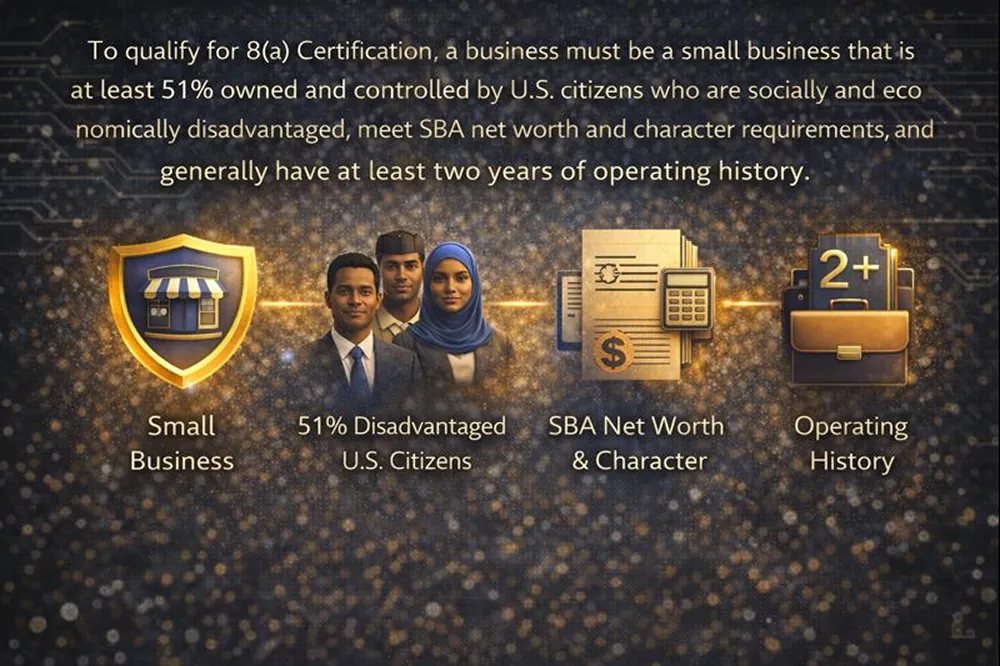
First, the business must be a small business according to SBA size standards for your industry. These standards vary by sector and are typically based on either revenue or number of employees. The business must also be at least 51 percent owned and controlled by one or more socially and economically disadvantaged individuals who are U.S. citizens.

Social disadvantage refers to individuals who have been subjected to racial or ethnic prejudice or cultural bias. The SBA recognizes certain groups as presumptively socially disadvantaged, including Black Americans, Hispanic Americans, Native Americans, Asian Pacific Americans, and Subcontinent Asian Americans. Individuals not in these groups can still qualify by demonstrating social disadvantage through a detailed social disadvantage narrative.

Economic disadvantage means the individual's ability to compete in the free enterprise system has been impaired due to diminished capital and credit opportunities. The SBA evaluates personal net worth, which must not exceed $850,000 (excluding ownership interest in the applicant firm and primary residence). Additionally, the individual must demonstrate good character and potential for success. The business must have been in operation for at least two years, though exceptions exist for certain circumstances.

How Does the 8a Application Process Work?

The certification process can be complex, but understanding each step makes it manageable. The entire application is submitted through certify.sba.gov, the SBA's online certification platform also known as the System for Award Management (SAM) integration portal.

To begin your 8a application, you must first register your business in SAM.gov, which is required for any federal contractor seeking to do business with government agencies. This registration serves as your central vendor database record. Next, you'll create an account in the certification portal and begin the detailed application process.

The SBA application requires extensive documentation. You must submit personal and business federal tax returns for the most recent three years, personal financial statements for all individuals claiming disadvantaged status, business financial statements, evidence of citizenship, organizational documents (articles of incorporation, operating agreements), resumes of key personnel, and contracts or agreements that demonstrate business capabilities.

One of the most critical components is the social disadvantage narrative. This personal statement must demonstrate how you've experienced social disadvantage that has negatively impacted your ability to compete in business. The SBA requires specific, detailed examples with supporting evidence. Many applicants underestimate the importance of this narrative—it should be thorough, compelling, and well-documented.

After submission, the SBA evaluates your application, which typically takes 90 days but can extend longer if the agency requests additional information or clarification. The local SBA district office will review your materials and may request an interview. During this period, maintaining open communication with your SBA reviewer and responding promptly to requests significantly improves your chances of approval.

What Are the Key Benefits of 8a Certification for Federal Contracting?

Obtaining certification unlocks numerous advantages that can dramatically accelerate business growth. The most significant benefit from the program is access to federal contracts through both competitive and sole-source contracts awarded exclusively to 8a participants.

Sole-source contracts represent a particularly valuable opportunity. Federal agencies can award contracts up to $4 million for goods and services (or $7 million for manufacturing) directly to an 8a-certified business without competitive bidding. This streamlined process allows certified business owners to secure federal contract awards more quickly and with less competition.

The program also provides access to competitive set-aside contracts where only 8a-certified businesses can bid. These set-aside opportunities reduce the competitive field significantly, giving small disadvantaged businesses a realistic chance to compete for contracts against similarly sized companies rather than large, established contractors.

Beyond contract opportunities, the SBA offers comprehensive business development support. Participants receive one-on-one counseling, training programs, workshops, and networking events. The mentor-protégé program connects newer 8a firms with experienced contractors who provide guidance, resources, and sometimes even teaming opportunities on larger contracts.

8a certification also offers marketing advantages. Being certified signals to federal agencies and prime contractors that your business has been vetted and meets rigorous standards. The SBA provides participants with marketing support and actively promotes 8a businesses to procurement officials across federal agencies.

Financial benefits extend beyond contract awards. Program participants may access sole-source contracts that provide stable revenue, making it easier to qualify for business loans and lines of credit. The certification demonstrates credibility to both government and commercial clients, opening doors beyond just federal contracting opportunities.

How Can You Prepare a Strong Social Disadvantage Narrative?

The social disadvantage narrative often determines whether your 8a certification application succeeds or fails. This detailed personal statement must demonstrate that you've experienced chronic and substantial social disadvantage that has negatively impacted your entry into or advancement in business.

Your narrative should begin with your personal background, including where you were raised, your family circumstances, and early experiences with discrimination or bias. The SBA requires specific examples—vague generalizations won't suffice. Document specific instances where you faced discrimination in education, employment, or business settings, explaining how these experiences created barriers to opportunity.

When describing disadvantaged experiences, connect them directly to business impact. For example, if you were denied loans or investment capital, explain how this limited your business's growth trajectory compared to peers without such barriers. If you faced workplace discrimination that limited advancement opportunities, demonstrate how this affected your ability to accumulate capital, experience, or professional networks necessary for business success.

Supporting documentation strengthens your narrative significantly. Include letters from individuals who can corroborate your experiences, evidence of denied loans or opportunities, or other materials that substantiate your claims. The more specific and documented your narrative, the stronger your application.

Avoid common pitfalls: don't minimize your experiences or appear uncertain about your disadvantage, but also don't exaggerate or make unsupportable claims. The tone should be professional and factual rather than emotional. Many successful applicants work with consultants who specialize in government proposal writing to ensure their narrative meets SBA expectations.

Remember that individuals not in presumptively disadvantaged groups can still qualify but face a higher burden of proof. These applicants must provide even more detailed evidence demonstrating how their specific circumstances constitute social disadvantage under SBA rules.

What Documentation Do You Need for Your 8a Certification Application?

Thorough preparation of required documents accelerates the certification timeline and reduces requests for additional information or clarification from the SBA. Understanding exactly what the business must submit prevents delays that can extend the process by months.

Financial documentation forms the foundation of your application. You must submit business and personal federal tax returns for the previous three years. These demonstrate your business's financial trajectory and your personal economic status. Personal financial statements for all individuals claiming disadvantaged status must detail assets, liabilities, income, and expenses. Business financial statements—including balance sheets, profit and loss statements, and cash flow statements—should be professionally prepared.

Ownership and control documents prove that socially and economically disadvantaged individuals own at least 51 percent of the business and control its management and daily operations. Submit corporate bylaws, operating agreements, stock certificates, voting agreements, and organizational charts. The SBA evaluates whether disadvantaged owners truly control major business decisions or if non-disadvantaged parties retain effective control.

Personal identification and citizenship documents are required for all owners claiming disadvantaged status. Submit birth certificates, passports, or naturalization papers to prove U.S. citizenship. Resumes for all key personnel demonstrate the management team's qualifications and experience.

Business capability evidence shows your firm has the experience and expertise to perform federal contracts. Include past contracts, client references, licenses, certifications, facility descriptions, and equipment lists. For firms with less than two years operating history seeking an exemption, provide detailed explanations of why you should qualify despite not meeting this standard requirement.

The certification application also requires information about any business relationships that might affect your 8a eligibility. Disclose relationships with former employers, family members in similar businesses, or other circumstances that the SBA may evaluate when determining independence and control.

How Long Does 8a Certification Last and What Are the Ongoing Requirements?

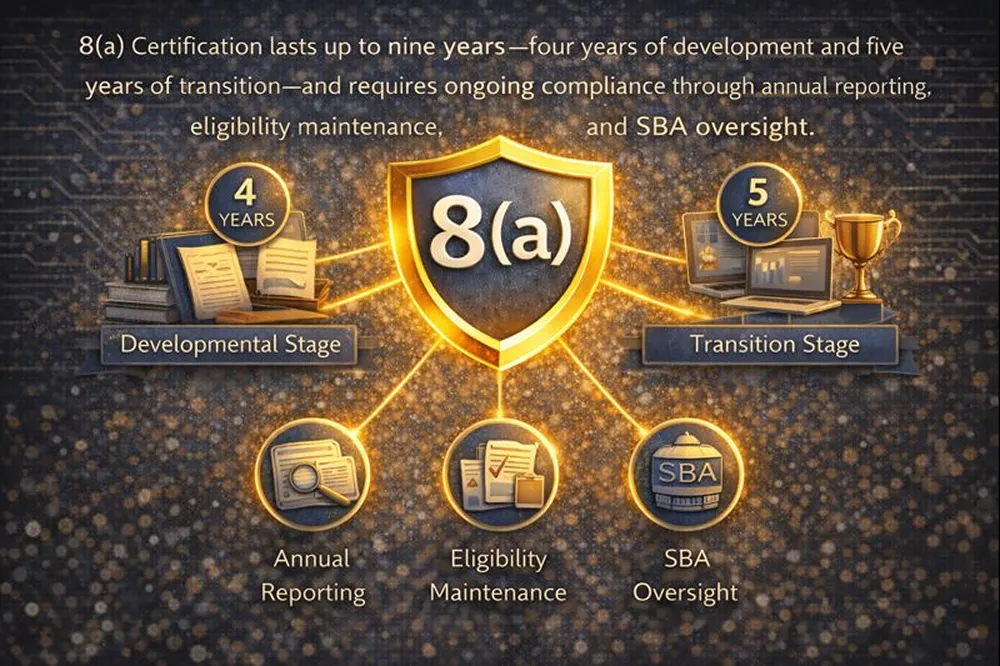
Understanding the program's timeline and compliance requirements helps you maximize benefits while meeting your obligations. The 8a certification offers nine years of participation divided into two phases: a four-year developmental stage and a five-year transition stage.

During the developmental stage, the SBA provides intensive business development assistance, training, and counseling to help small businesses build capacity. Firms can receive sole-source contracts during this phase, though dollar limitations apply. The transition stage focuses on preparing businesses to compete in the federal market without program support. Firms are expected to graduate from the program with the capability to compete for contracts independently.

Throughout participation, certified business owners must comply with reporting requirements to maintain good standing. Annual financial statements must be submitted to demonstrate continued eligibility. The business must report all contracts awarded, subcontracts performed, and revenue generated. The SBA monitors whether participants are meeting program goals and whether their business growth remains within size standards.

The business must continue meeting eligibility criteria throughout the nine-year period. If your firm exceeds size standards for your industry, you may be graduated early. If ownership changes such that socially and economically disadvantaged individuals no longer own at least 51 percent or control the company, certification terminates immediately.

Additionally, the SBA may conduct reviews to verify ongoing compliance with program rules. These reviews can occur at any time and may include site visits, interviews with key personnel, and examination of business records. Maintaining accurate records and transparent operations ensures smooth reviews.

Failure to comply with reporting requirements or program rules can result in penalties, suspension, or termination from the 8a program. However, the SBA also provides guidance to help participants maintain compliance, and your district office representative is available to answer questions throughout your participation.

How Does the Mentor-Protégé Program Enhance 8a Benefits?

The mentor-protégé program represents one of the most valuable yet underutilized aspects of 8a certification. This program pairs experienced federal contractors (mentors) with 8a-certified firms (protégés) to provide business development assistance and create pathways to larger contracts.

Mentors are typically established government contractors with expertise in navigating the federal contracting space. They provide protégés with technical assistance, management guidance, financial assistance (including equity investments or loans), and assistance with contract performance. Many mentor relationships result in teaming agreements where the mentor and protégé jointly pursue contracts specifically for small businesses, with the protégé serving as prime contractor.

The program benefits both parties. Protégés gain invaluable knowledge, resources, and experience from established contractors while building their track record. Mentors gain access to 8a set-aside opportunities through their protégé relationships and can receive credit toward their own small business subcontracting goals.

To participate, both mentor and protégé must apply to the SBA. The application must include a detailed mentor-protégé agreement outlining the assistance to be provided, milestones, and duration of the relationship. The SBA reviews and approves these agreements to ensure they comply with program requirements and benefit the protégé's development.

One significant advantage is that joint ventures between 8a mentors and protégés receive favorable treatment. These partnerships can bid on 8a contracts as the protégé firm while leveraging the mentor's experience and past performance. For many small disadvantaged businesses, these relationships provide the credibility needed to win significant federal contracts they couldn't pursue independently.

The SBA sets guidelines to prevent abuse while encouraging genuine development relationships. Mentors cannot charge protégés for assistance, and the relationship must demonstrably benefit the protégé's growth. Regular reporting ensures the arrangement serves its intended purpose of helping small businesses build capacity.

What Strategies Help 8a Certified Businesses Win Federal Contracts?

Leverage 8a certification effectively by combining your program status with strategic business development approaches. Simply having certification doesn't guarantee contract awards—you must actively pursue opportunities and position your business competitively.

Start by understanding the government procurement cycle and where 8a opportunities fit within it. Federal agencies plan their contract needs months or years in advance. Building relationships with agency procurement officials before they issue solicitations positions your business favorably when opportunities arise.

Utilize multiple tools to identify contract opportunities. Register on SAM.gov and create a comprehensive profile highlighting your 8a status and capabilities. Monitor contract opportunities through various tools to find government contract bid and RFP opportunities specific to your industry and expertise. The SBA also maintains databases of 8a opportunities and can connect certified businesses with agencies seeking small disadvantaged contractors.

When responding to solicitations, develop winning strategies for government RFP responses that emphasize your unique value proposition. Highlight your 8a certification status, past performance, technical capabilities, and understanding of agency needs. Quality proposals that demonstrate clear understanding of contract requirements significantly outperform generic submissions.

Build past performance through smaller contracts first. Federal agencies heavily weight past performance when evaluating proposals. Start with smaller set-aside contracts to build a track record, then pursue progressively larger opportunities. Document successful contract performance meticulously—agencies will request detailed past performance information.

Network within the government contracting community. Attend industry days, small business conferences, and agency-specific outreach events. The SBA offers matchmaking events connecting 8a businesses with procurement officials. These relationships often lead to opportunities for sole-source contracts or advance notice of upcoming competitive solicitations.

Consider subcontracting opportunities with prime contractors on larger contracts. Many large government contractors must meet small business subcontracting goals, and partnering with established primes provides valuable experience and revenue while building relationships that can lead to teaming arrangements on future prime opportunities.

Finally, invest in capability statements, marketing materials, and a professional website that clearly communicates your 8a status and capabilities. Government agencies and prime contractors often research potential partners online, and professional presentation creates positive first impressions that differentiate your business from competitors.

How Does 8a Certification Differ from Other Small Business Certifications?

Understanding how 8a certification relates to other federal certifications helps you determine which programs best suit your business and whether pursuing multiple certifications makes strategic sense.

The 8a certification program focuses specifically on socially and economically disadvantaged individuals and provides the most comprehensive business development support among SBA programs. Unlike general small business certifications, 8a offers sole-source contract authority and dedicated set-aside opportunities that significantly reduce competition.

Other SBA certifications include Women-Owned Small Business (WOSB), Service-Disabled Veteran-Owned Small Business (SDVOSB), and HUBZone certifications. Each targets different demographics and provides access to different set-aside contracts. A business may qualify for multiple certifications simultaneously—for example, a Hispanic woman-owned firm could potentially hold both 8a and WOSB certifications, expanding access to government contracting opportunities across multiple programs.

The Small Disadvantaged Business (SDB) certification, while related to 8a, is distinct. SDB certification can be obtained through the SBA or through third-party certifying organizations and provides preferential evaluation in certain federal contracts but doesn't include the business development program benefits or sole-source authority available to 8a participants.

8a certification offers advantages beyond just access to federal contracts. The comprehensive support infrastructure—including free business counseling, training, and the mentor-protégé program—distinguishes it from other certifications that primarily provide set-aside access without developmental support. For businesses owned by socially and economically disadvantaged individuals seeking to compete in the federal contracting arena, 8a typically provides the most substantial benefits.

However, the 8a program has stricter eligibility requirements than many other certifications, particularly regarding personal net worth limitations and the social disadvantage demonstration. The certification application process is more extensive and time-consuming, but the potential returns justify the investment for eligible businesses serious about success in the federal marketplace.

What Common Mistakes Should You Avoid When Seeking 8a Certification?

Many qualified businesses fail to obtain certification due to avoidable errors during the application process. Understanding these common pitfalls helps you navigate the process successfully.

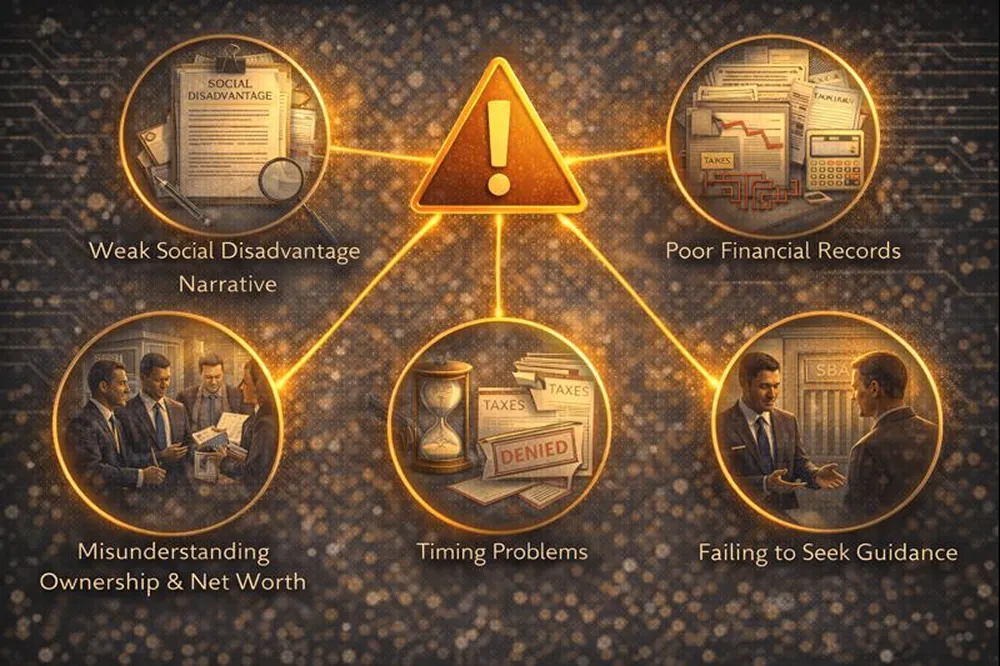
One frequent mistake involves inadequate preparation of the social disadvantage narrative. Many applicants submit generic narratives lacking specific examples and documentation. The SBA requires detailed, personal accounts of how disadvantage impacted your business opportunities. Invest significant time crafting this narrative and provide supporting evidence for your claims.

Financial disorganization undermines many applications. Incomplete financial records, inconsistent tax returns, or inability to document business financial performance raise red flags with SBA evaluators. Ensure all financial documentation is accurate, complete, and professionally prepared before submission. Discrepancies between tax returns and financial statements require clear explanation.

Misunderstanding ownership and control requirements causes frequent denials. The business must be at least 51 percent owned by socially and economically disadvantaged individuals who also control management and daily operations. Business structures that give non-disadvantaged parties veto power over major decisions or that restrict disadvantaged owners' control fail to meet the requirements, even if disadvantaged individuals hold majority ownership.

Many applicants exceed personal net worth limits without realizing it. The $850,000 personal net worth cap (excluding business ownership interest and primary residence) must be calculated carefully. Some applicants fail to properly value assets or overlook includable items, leading to denials when SBA evaluates their actual net worth.

Waiting until the last minute to begin the application creates problems. The certification process requires gathering extensive documentation, some of which may take weeks to obtain. Starting early allows time to address missing documents or correct issues before submission. The SBA may request additional information or clarification during review, and delayed responses can significantly extend the timeline.

Some businesses apply before meeting the two-year operating requirement without qualifying for an exemption. While exceptions exist, most businesses need at least two years of tax returns and operating history. Applying prematurely results in denial and requires restarting the process later.

Finally, many applicants fail to leverage available assistance. The local SBA district office provides free counseling to help businesses understand requirements and prepare applications. Small Business Development Centers (SBDCs), Women's Business Centers, and other SBA resource partners offer assistance with the certification application. For complex situations, consulting with specialists experienced in the 8a certification for small business applications can significantly improve success rates. If you need guidance throughout this process, contact experienced professionals who understand the intricacies of federal certifications.

Key Takeaways: Essential Points to Remember About 8a Certification

Critical Eligibility Requirements:

  • Business must be at least 51 percent owned and controlled by socially and economically disadvantaged individuals who are U.S. citizens
  • Personal net worth of disadvantaged owners cannot exceed $850,000 (excluding business ownership and primary residence)
  • Business must meet SBA size standards for its industry and generally have two years of operating history
  • Must demonstrate good character and potential for success in federal contracting

Application Process Essentials:

  • Complete application through certify.sba.gov after registering in SAM.gov
  • Prepare comprehensive documentation including three years of tax returns, financial statements, ownership documents, and detailed social disadvantage narrative
  • Expect 90+ day review period and be prepared to respond promptly to SBA requests for additional information
  • Social disadvantage narrative must include specific, documented examples of how disadvantage impacted business opportunities

Program Benefits and Structure:

  • Nine-year participation divided into four-year developmental stage and five-year transition stage
  • Access to sole-source contracts up to $4 million ($7 million for manufacturing) without competition
  • Competitive set-aside contracts reserved exclusively for 8a-certified businesses
  • Comprehensive business development support including training, counseling, and mentor-protégé program
  • Marketing advantages and credibility with federal agencies and prime contractors

Strategic Success Factors:

  • Build relationships with federal agencies and procurement officials before solicitations are released
  • Start with smaller contracts to establish past performance, then pursue progressively larger opportunities
  • Utilize mentor-protégé program to gain experience, resources, and access to larger contracts through joint ventures
  • Maintain compliance with reporting requirements and program rules throughout nine-year participation
  • Combine 8a status with professional proposal development and strategic business development for maximum contract success

The 8a certification is access to a transformative opportunity for small businesses owned by socially and economically disadvantaged individuals. While the certification process can be complex, the program benefits—including access to government contracts, business development support, and competitive advantages within the federal marketplace—make it one of the most valuable resources available to help small businesses compete for contracts and achieve sustainable growth in government contracting.

Other Blogs

OryonIQ Events

Events

Are you curious about the networking events near you? Together we can expand your network and watch your pipeline exponentially grow.