InstagramFacebookLinkedinMediumYoutubeX
Oryon iq

Other Transaction Authority (OTA): A Comprehensive Guide to Alternative Federal Acquisition Agreements

Other Transaction Authority represents a revolutionary approach to federal contracting that bypasses traditional Federal Acquisition Regulation constraints, offering unprecedented flexibility for government agencies and contractors alike. This comprehensive guide explores how OTA contracts differ from conventional procurement methods, when they're appropriate, and how businesses can leverage these transaction agreements to access lucrative Department of Defense and federal agency opportunities. Whether you're a defense contractor seeking faster pathways to prototype development or a commercial sector innovator looking to work with government customers without FAR compliance burdens, understanding OTA mechanisms is essential for competing in today's dynamic federal marketplace.

What Is Other Transaction Authority and How Does It Differ from Traditional Contracts?

Other Transaction Authority, commonly referred to as OTA, is a unique procurement mechanism that allows federal agencies to enter into agreements for research, prototype projects, and production without following traditional Federal Acquisition Regulation (FAR) requirements. This broad authority provides flexibility that conventional contract types cannot match.

Unlike far-based contracts that require strict compliance with FAR clauses covering everything from cost accounting standards prescribed pursuant to section 1502 of title 41 and the regulations implementing such section to specific socioeconomic requirements, OTA agreements allow agencies and contractors to negotiate terms that better fit project needs. The transaction authority enables faster awards, streamlined processes, and more collaborative relationships between government and industry.

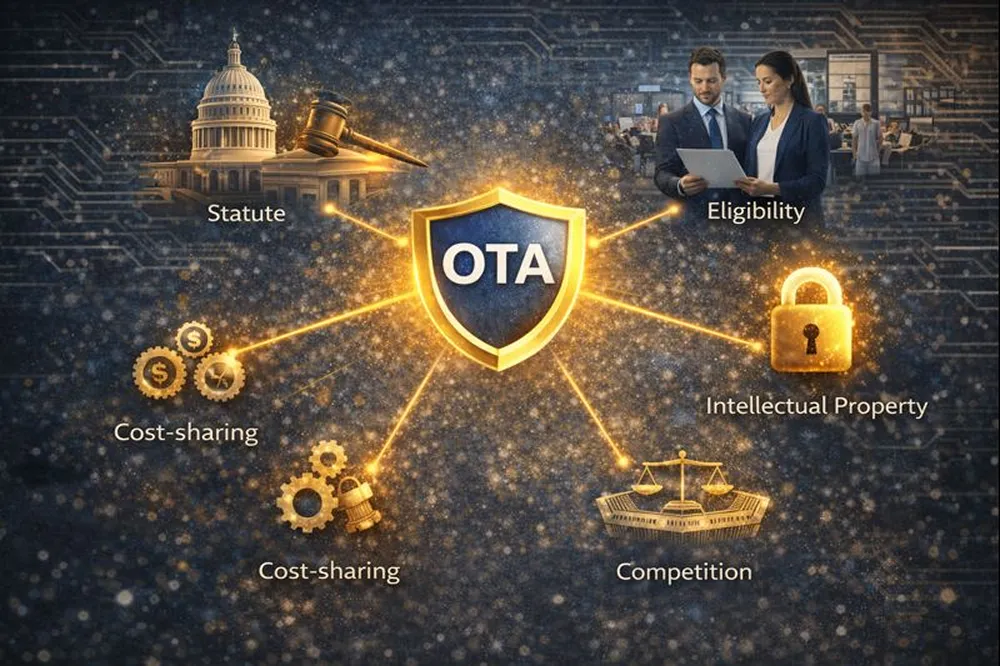
The statutory authority for OTA originates from specific congressional legislation. For the Department of Defense, the primary authorities are found in 10 U.S.C. 4021 (for research projects) and 10 U.S.C. 4022 (for prototype projects). These statutes explicitly grant DoD the authority to enter into transaction agreements that don't conform to standard procurement contracts, cooperative agreements, or grant structures. Other federal agencies must be explicitly authorized by Congress to use OTA, making it a carefully controlled but increasingly popular acquisition tool.

The flexibility of OTA extends beyond just regulatory relief. These agreements can incorporate cost-sharing requirements, allow for creative intellectual property arrangements, and accommodate commercial sector business practices that traditional government contracting typically prohibits. This makes OTA particularly attractive for dual-use technologies and for engaging nontraditional defense contractors who might otherwise avoid government work.

When Should Federal Agencies Use OTA Instead of FAR-Based Contracts?

The decision to use transaction authority rather than procurement contracts depends on several strategic factors. Agencies typically consider OTA when they need to access innovative technologies, engage nontraditional sources, or accelerate the acquisition process beyond what FAR contracts allow.

OTA is particularly valuable for prototype development. Under 10 U.S.C. 4022, DoD can "carry out prototype projects" that are directly relevant to enhancing the mission effectiveness of military personnel or supporting platforms, systems, components, or materials proposed for use by armed forces. The prototype authority allows for rapid experimentation and testing without the administrative burden that slows traditional procurement.

Another key scenario involves attracting entities that won't compete for traditional government contracts. Many commercial sector companies, particularly technology startups and innovative small businesses, avoid federal contracting due to FAR compliance costs and complexity. When at least one significant participant in the transaction is a nontraditional defense contractor—defined as an entity that is not currently performing and has not performed any contract or subcontract for the Department of Defense that is subject to full coverage under the cost accounting standards prescribed pursuant to section 1502 of title 41 during at least the one-year period preceding the solicitation—OTA becomes especially advantageous.

Research and development projects under 10 U.S.C. 4021 provide another appropriate use case. Research OTs support basic, applied, and advanced research projects that further defense capabilities. These agreements often involve universities, research institutions, and commercial laboratories that prefer the collaborative nature of OTA versus the restrictive terms of procurement contracts.

The National Defense Authorization Act and subsequent legislation have expanded OTA applicability. Agencies can now use this authority for follow-on production if certain conditions are met, including a written determination that the prototype OT agreement participants have successfully completed the prototype project and that production through OTA is cost-effective. This production OTA capability represents a significant evolution, allowing successful prototypes to transition directly to production without reverting to traditional contract types.

How Do OTA Consortiums Work and What Role Do They Play?

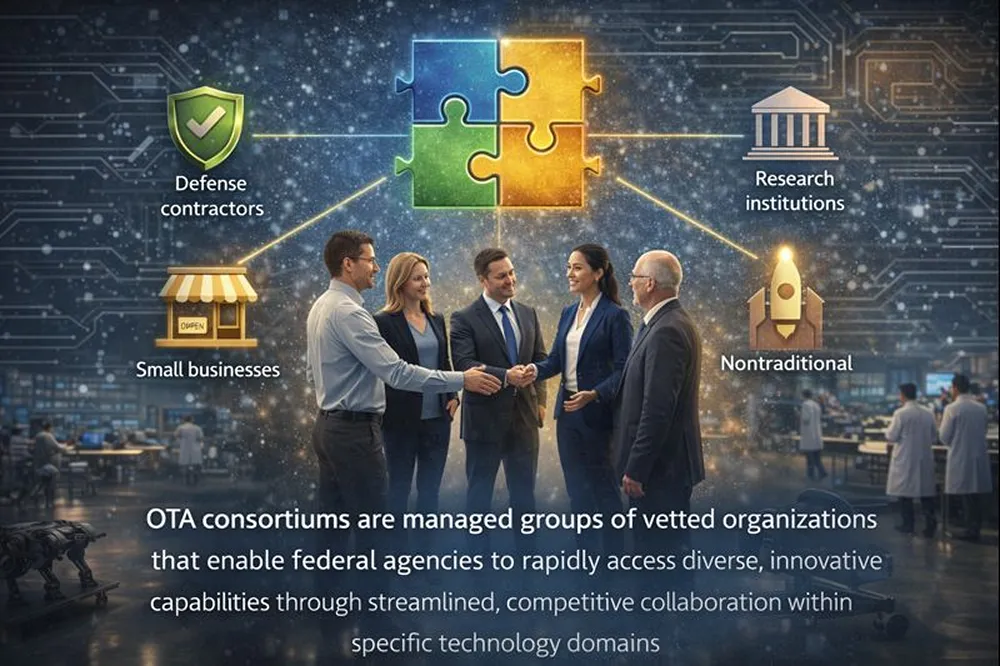
Consortium management represents one of the most distinctive features of modern OTA implementation. A consortium is a collaborative group of organizations—including defense contractors, small businesses, research institutions, and nontraditional entities—formed to compete for and execute OTA agreements within specific technology domains.

The consortium structure streamlines the acquisition process significantly. Rather than issuing individual solicitations to the entire vendor universe, DoD and other federal agencies can issue opportunities to established consortiums whose members have already been vetted. This approach reduces competition timelines from months to weeks while maintaining access to diverse capabilities across the commercial and defense industrial base.

A consortium management firm typically administers these groups, handling member recruitment, proposal coordination, compliance oversight, and reporting requirements. The consortium member organizations benefit from reduced proposal costs, networking opportunities, and streamlined access to government sponsors. For the government, consortiums provide a curated pool of capable performers ready to respond quickly to emerging needs.

Several prominent consortiums operate across different technology areas. For example, consortiums focused on advanced research projects in areas like artificial intelligence, hypersonics, biotechnology, and space systems have become central to how DoD pursues innovation. These consortiums often include hundreds of members ranging from major defense primes to university laboratories to venture-backed startups.

Membership requirements vary by consortium but typically involve demonstrating relevant technical capabilities, agreeing to consortium operating procedures, and paying membership fees. Once admitted, consortium members receive access to solicitation notices, can propose as prime contractors or team members, and participate in technology development discussions with government customers. Understanding government procurement cycles within the consortium context helps members position themselves effectively for opportunities.

The cooperative nature of consortiums doesn't eliminate competition—members still compete against each other for specific awards. However, the consortium framework creates an environment where collaboration and competition coexist, allowing participants in the transaction to form teams that combine complementary capabilities for complex projects.

What Are the Different Types of Other Transaction Agreements?

Understanding the distinct categories of OTA helps contractors identify appropriate opportunities and structure competitive proposals. The primary types include research OTs, prototype OTs, and production OTAs, each with unique characteristics and applications.

Research OTs, authorized under 10 U.S.C. 4021, support basic and applied research projects. These agreements typically involve universities, research labs, and early-stage technology companies exploring novel concepts without immediate application requirements. Research OTs often include cooperative agreements where multiple parties contribute resources toward shared objectives. Cost-sharing requirements are common but flexible, with government and industry negotiating appropriate contribution levels based on mutual benefit and commercial potential.

Prototype OT agreements, governed by 10 U.S.C. 4022, represent the most commonly used OTA category. A prototype project develops and demonstrates technology concepts, proving feasibility before committing to full-scale production. Prototype OTA contracts can range from software development to hardware systems, from laboratory demonstrations to field testing with military units. The prototype authority specifically requires that projects be directly relevant to enhancing mission effectiveness of armed forces or support platforms and systems.

The prototype phase provides crucial risk reduction, allowing DoD to evaluate performance, cost, and operational suitability before production decisions. Unlike traditional procurement, where detailed specifications are established upfront, prototype agreements embrace iterative development, allowing contractors to refine approaches based on testing results and user feedback.

Follow-on production contracts or transactions represent the newest evolution of OTA. Previously, successful prototypes required transitioning to FAR-based contracts for production, creating discontinuity and delay. Current law allows agencies to use OTA for follow-on production if the original prototype was executed under OTA, the prototype met performance objectives, and the agency determines OTA production is cost-effective. This streamlined pathway from concept to production represents a significant advantage for both government and industry.

Commercial solutions openings represent a specialized OTA approach focused on rapidly acquiring existing commercial products or services that can meet government needs with minimal modification. These abbreviated competitions emphasize speed and commercial practice adoption, with simplified proposal requirements and accelerated evaluation timelines.

What Are the Key Benefits of OTA for Government and Contractors?

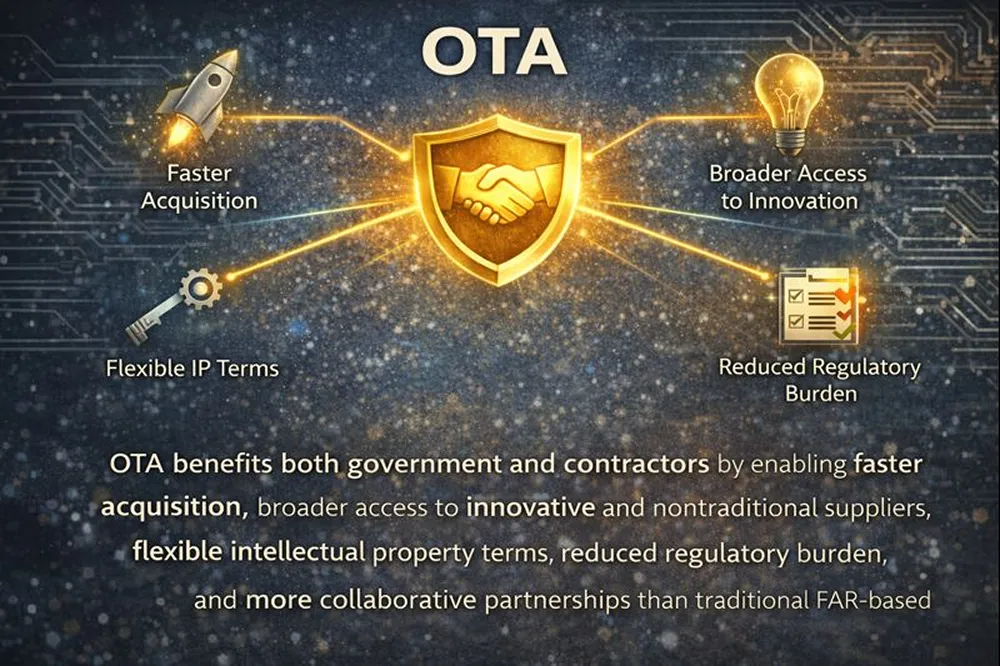
The advantages of transaction authority extend to both government agencies and participating contractors, creating mutual incentives for using this acquisition approach. Understanding these benefits helps explain OTA's growing popularity.

For federal agencies, particularly the Department of Defense, OTA provides access to innovation that traditional procurement often cannot reach. Nontraditional defense contractors, especially technology companies and startups, frequently refuse to engage with conventional government contracting due to regulatory burdens, long timelines, and unfavorable business terms. OTA's flexibility removes many of these barriers, expanding the industrial base beyond traditional sources.

Speed represents another critical advantage. FAR-based contract awards can take years from requirement definition to contract execution, while OTA agreements can be finalized in months or even weeks through consortium vehicles. This acceleration is particularly valuable for rapidly evolving technologies where delayed acquisition means fielding obsolete capabilities. The streamlined acquisition process allows government sponsors to respond to emerging threats and opportunities with appropriate urgency.

Intellectual property arrangements under OTA provide flexibility that procurement contracts cannot match. Rather than standard government rights to technical data and computer software, OTA allows negotiated IP terms that protect commercial investments while ensuring government access for operational needs. This balance encourages contractors to bring their best commercial technologies rather than developing separate, inferior government-specific versions.

For contractors, particularly those in the commercial sector, OTA eliminates many compliance burdens associated with FAR contracts. Cost accounting standards, Truth in Negotiations Act requirements, and numerous socioeconomic clauses either don't apply or can be tailored. This regulatory relief significantly reduces overhead costs and administrative complexity.

The cooperative nature of OTA agreements fosters true partnership between government and industry. Rather than the adversarial dynamics that sometimes characterize traditional procurement, OTA emphasizes collaboration, shared risk, and mutual success. This approach produces better outcomes, stronger relationships, and more effective solutions to complex challenges.

Small businesses particularly benefit from OTA accessibility. While traditional defense contracting can be prohibitively complex for newer companies, consortium membership provides guided pathways to government work. Many consortiums specifically recruit and support small business participation, recognizing that innovation often comes from non-traditional sources. In fact, a significant percentage of entities working with the federal government through OTA consortiums are small businesses that might never engage through conventional channels.
How Does the OTA Proposal and Award Process Work?

Understanding the OTA solicitation and evaluation process helps contractors develop winning strategies for government RFP responses specific to transaction authority competitions. While OTA provides flexibility, successful proposals still require strategic development and clear value articulation.

OTA solicitations typically come through consortium management firms rather than traditional platforms, though some opportunities appear on SAM.gov and other tools to find government contract and RFP opportunities. Consortium members receive direct notification of relevant opportunities within their technology focus areas.

Proposal requirements for OTA are generally less prescriptive than FAR-based solicitations. Rather than detailed technical volumes, cost volumes, and past performance volumes following strict page limits and formats, OTA solicitations often request white papers, technical approach narratives, and simplified cost proposals. This streamlined approach reduces proposal costs and allows contractors to communicate their solutions more naturally.

The evaluation process emphasizes technical merit and value rather than lowest price technically acceptable approaches common in traditional procurement. Agencies evaluate proposals based on criteria including technical innovation, feasibility, team qualifications, and cost reasonableness. Unlike FAR contracts that require strict source selection procedures, OTA evaluations can be more flexible and conversational, sometimes involving discussions, site visits, or oral presentations before award decisions.

Negotiations play a central role in OTA awards. After selecting preferred offerors, government representatives work with contractors to refine technical approaches, adjust cost structures, clarify intellectual property terms, and establish performance metrics. This collaborative negotiation produces agreements tailored to specific project needs rather than standardized contract documents.

Award timelines vary significantly but generally move faster than traditional contracts. Through established consortiums, some awards occur within 60-90 days from solicitation release. For complex prototype projects outside consortium structures, timelines may extend to several months but still represent significant acceleration compared to procurement contracts.

Post-award administration differs from conventional contract management. Rather than contracting officer oversight focused on FAR compliance, OTA agreements typically involve technical monitors who emphasize performance achievement and collaborative problem-solving. This approach reduces administrative burden while maintaining accountability through milestone-based funding and regular technical reviews.

What Are the Limitations and Requirements for Using OTA?

Despite its flexibility, transaction authority operates within specific boundaries established by statute and policy. Understanding these constraints helps contractors and agencies use OTA appropriately while avoiding compliance issues.

The statutory authority for OTA is limited to purposes explicitly authorized by Congress. While DoD has broad authority for research, prototypes, and certain production activities, other federal agencies possess more restricted OTA powers. Agencies must carefully verify their authority to use OTA for specific purposes before issuing solicitations, and contractors should confirm that proposed agreements fall within applicable statutory boundaries.

For prototype OT agreements under 10 U.S.C. 4022, DoD must meet specific conditions. At least one of two requirements must be satisfied: either at least one significant participant in the transaction must be a nontraditional defense contractor, or all participants must agree to a financial or in-kind cost share of at least one-third of total project cost. These requirements ensure OTA expands the defense industrial base or leverages commercial investment rather than simply providing regulatory relief to traditional contractors.

The nontraditional contractor definition is precise: an entity that has not performed any contract or subcontract for DoD subject to full coverage under cost accounting standards during the one-year period preceding the solicitation. Companies must carefully evaluate whether they qualify as nontraditional, as misrepresentation can invalidate agreements and result in serious consequences.

Cost-sharing requirements, when applicable, must represent real contributions. Financial contributions involve actual monetary investments by contractors, while in-kind contributions include labor, facilities, equipment, or other resources devoted to the project. The government evaluates whether proposed cost shares are reasonable and meaningful rather than simply accounting maneuvers to meet threshold requirements.

Follow-on production through OTA requires meeting additional criteria established in 10 U.S.C. 4022. The senior procurement executive or designated official must make a written determination that: (1) the prototype project was awarded competitively under OTA using competitive procedures, (2) competitive procedures would be used for the production contract or transaction, (3) the transaction will provide for production of a weapon or weapon system directly relevant to enhancing mission effectiveness, and (4) the senior procurement executive determines production OTA is in the best interest of DoD. These requirements ensure production OTAs are used appropriately rather than as blanket alternatives to traditional procurement.

Intellectual property rights, while flexible, must still balance government needs with contractor interests. Agencies cannot simply accept unlimited proprietary claims, particularly for technologies developed substantially with government funding. Negotiated data rights must ensure government can use, maintain, and compete systems while protecting legitimate commercial interests in background IP and privately-funded developments.

How Can Companies Successfully Compete for OTA Opportunities?

Winning OTA awards requires strategies different from traditional government contracting. Companies must position themselves effectively, develop strong proposals, and build relationships that support long-term success in this unique acquisition environment.

First, evaluate consortium membership. Joining established consortiums in your technology domain provides direct access to opportunities and significantly simplifies the pursuit process. Research active consortiums through the National Center for Defense Manufacturing and Machining, the Defense Innovation Unit's consortium portal, and through DoD program offices in your area of expertise. Membership often requires application review and fees but provides substantial benefits including networking, visibility, and streamlined proposal processes.

For companies qualifying as nontraditional defense contractors, emphasize this status prominently. Your nontraditional designation makes you particularly valuable for prototype OT agreements and can be a decisive factor in source selection. Clearly explain how your commercial sector expertise, innovative approaches, or unique capabilities bring value that traditional defense contractors cannot replicate.

Build relationships with government sponsors before solicitations are released. Unlike traditional procurement where pre-solicitation communication is limited, OTA encourages dialogue. Attend industry days, participate in technical interchange meetings, and engage with program managers to understand needs and demonstrate capabilities. These relationships often determine which companies receive solicitation notifications and who government evaluators already trust to perform successfully.

Develop proposals emphasizing innovation and technical merit rather than compliance. OTA evaluators look for creative solutions, clear technical approaches, and demonstrated expertise. Unlike traditional government proposal writing that emphasizes process and compliance, OTA proposals should read more like commercial business plans with clear value propositions and straightforward technical narratives.

Form strategic teams combining complementary capabilities. Consortiums facilitate teaming among members, allowing companies to combine technical expertise, past performance, and resources. Small businesses should seek partnerships with established performers who can provide mentorship and credentials while benefiting from the small business's innovation and agility.

Understand and articulate your intellectual property strategy clearly. Government evaluators need confidence that you'll provide necessary data rights for operational use while protecting commercial investments appropriately. Proposals should explicitly address what IP exists, what will be developed, and what rights government will receive. Ambiguity on IP issues creates evaluation concerns that can eliminate otherwise strong proposals.

Maintain flexible business practices that accommodate OTA's collaborative nature. Companies accustomed to fixed-price commercial contracts or rigid government procurement must adapt to milestone-based funding, iterative development approaches, and ongoing technical collaboration. Organizations that embrace these practices and demonstrate ability to work in partnership rather than transactional modes consistently win OTA awards.

What Are Common Misconceptions About Other Transaction Authority?

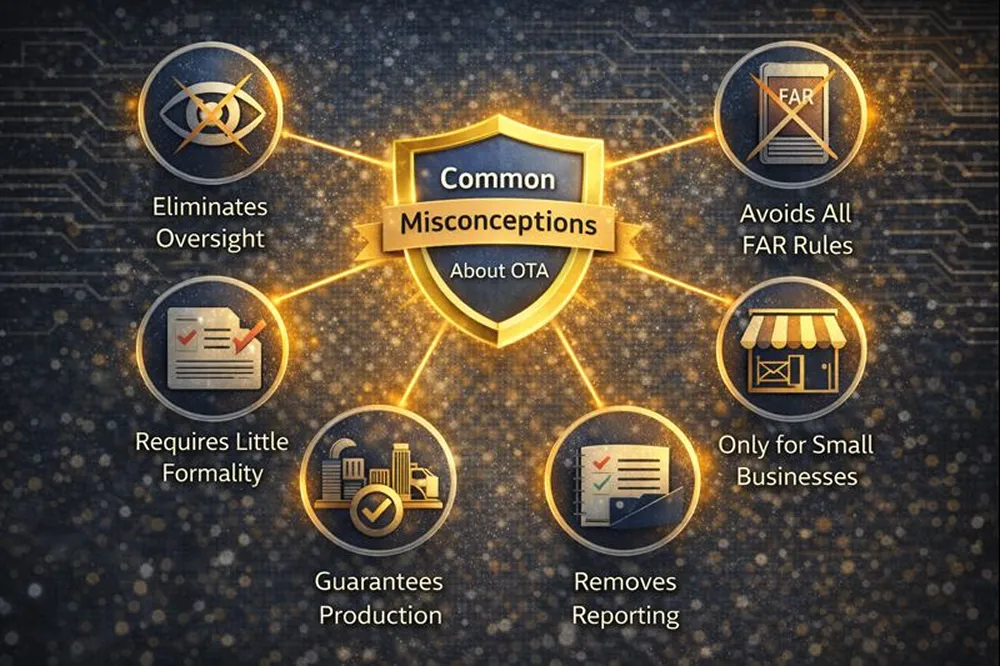
Several myths about OTA persist in the contracting community, creating confusion and sometimes causing companies to pursue or avoid opportunities based on incorrect information. Clarifying these misconceptions helps contractors make informed decisions about OTA engagement.

Misconception 1: OTA means no oversight or accountability. While OTA provides flexibility, it doesn't eliminate oversight. Agreements include clear technical milestones, performance metrics, and reporting requirements. Government monitors track progress, conduct reviews, and ensure taxpayer funds produce expected results. The oversight approach differs from FAR compliance monitoring but remains rigorous regarding technical performance and financial accountability.

Misconception 2: Any company can use OTA to avoid FAR regulations. OTA is not a universal escape from procurement rules. Statutory requirements, particularly for prototype authority, mandate either nontraditional contractor participation or cost-sharing. Traditional defense contractors cannot simply choose OTA instead of FAR contracts for standard requirements. The transaction authority serves specific purposes—innovation, prototype development, and industrial base expansion—not general procurement convenience.

Misconception 3: OTA proposals require no structure or formality. While less prescriptive than FAR solicitations, OTA competitions still require professional, well-organized proposals. Evaluators need clear technical approaches, realistic cost estimates, and demonstrated qualifications. Treating OTA proposals casually because they're "more flexible" results in elimination during evaluation. The streamlined format actually demands greater clarity and stronger technical content since elaborate compliance sections don't obscure weak substance.

Misconception 4: OTA agreements are only for small businesses and startups. While OTA excels at engaging nontraditional entities including small businesses, large defense contractors participate extensively in OTA agreements, often as team members or consortium participants. Major primes increasingly use OTA as a vehicle for innovation and rapid capability development alongside their traditional contract portfolios.

Misconception 5: Follow-on production through OTA guarantees production awards. Having a prototype OT doesn't automatically lead to production OTA. Agencies must meet statutory requirements including competitive procedures for production, successful prototype completion, and senior executive determination that OTA production serves government interests. Contractors should view prototype agreements as opportunities to demonstrate capability rather than guaranteed production pathways.

Misconception 6: OTA eliminates all reporting and data requirements. While OTA provides flexibility on certain regulatory requirements, agreements still typically include financial reporting, technical progress reports, and data deliverables tailored to project needs. The specific requirements are negotiated rather than automatically imposed, but government sponsors still need information to manage programs effectively.

How Is OTA Evolving and What Does the Future Hold?

The use of other transaction authority continues to expand as federal agencies recognize its value for addressing complex acquisition challenges. Understanding current trends and likely future developments helps contractors position themselves strategically for emerging opportunities.

Transaction authority usage has grown dramatically over the past decade. The Department of Defense now obligates billions annually through OTA agreements, representing a substantial portion of research and development funding. This growth reflects OTA's proven effectiveness for rapid innovation and industrial base expansion. As more program offices gain experience with OTA, adoption will likely continue accelerating across DoD and potentially expand to other federal agencies.

Congress continues refining OTA authorities through successive National Defense Authorization Acts and other legislation. Recent expansions include production authority enhancements, increased thresholds for individual OTs, and clarifications regarding cost-sharing and nontraditional contractor definitions. This legislative evolution suggests continued congressional support for transaction authority as a strategic acquisition tool.

The consortium model is maturing and proliferating. As established consortiums demonstrate value, new consortiums form in emerging technology domains. This ecosystem approach to acquisition creates persistent vehicles for innovation, allowing government customers to rapidly access capabilities without repeatedly establishing new contractual mechanisms. The consortium framework also facilitates small business participation and encourages collaboration between traditional and nontraditional entities.

Software and digital technologies increasingly dominate OTA activities. As military effectiveness depends more heavily on software, cyber capabilities, artificial intelligence, and data systems, OTA's flexibility for iterative development and commercial technology adoption makes it ideal for digital acquisitions. Expect continued growth in software-focused prototype projects and production transitions through OTA channels.

Integration between OTA and traditional procurement will likely improve. Rather than viewing OTA and FAR contracts as completely separate, forward-thinking acquisition professionals are developing complementary strategies that use OTA for innovation and rapid prototyping while transitioning proven solutions to traditional contracts for large-scale production when appropriate. This hybrid approach maximizes each mechanism's strengths.

Policy development around OTA continues evolving. DoD and other agencies are issuing guidance clarifying best practices, establishing approval processes, and ensuring appropriate use of transaction authority. While maintaining flexibility remains paramount, some standardization helps ensure consistent application and reduces confusion among both government personnel and contractors. If you're considering pursuing OTA opportunities and need guidance on how they fit into your federal contracting strategy, contact specialized advisors who understand both traditional and alternative acquisition pathways.

International interest in OTA-like authorities is growing as allied nations observe U.S. success in leveraging flexible acquisition mechanisms for innovation. While implementation varies by country and legal framework, the general principle of providing alternatives to rigid procurement regulations for certain circumstances is gaining traction globally, potentially creating opportunities for companies working across international markets.

Key Takeaways: Essential Points About Other Transaction Authority

Fundamental OTA Characteristics:

  • Other Transaction Authority provides federal agencies with broad authority to enter into research, prototype, and production agreements outside Federal Acquisition Regulation requirements
  • OTA contracts offer significant flexibility in areas including intellectual property rights, cost-sharing arrangements, and business terms that accommodate commercial sector practices
  • Primary DoD authority comes from 10 U.S.C. 4021 for research and 10 U.S.C. 4022 for prototype projects, with recent expansion to include follow-on production under specific conditions
  • Other federal agencies must be explicitly authorized by Congress to use transaction authority for their specific missions

Critical Requirements and Limitations:

  • Prototype OT agreements require either at least one nontraditional defense contractor as a significant participant or cost-sharing of at least one-third by all participants
  • Nontraditional contractors are entities that haven't performed contracts subject to full coverage under cost accounting standards prescribed pursuant to section 1502 of title 41 during at least the one-year period preceding the solicitation
  • Follow-on production through OTA requires written determination by senior procurement executive confirming competitive prototype award, planned competitive production procedures, mission relevance, and determination that OTA production serves government interests
  • While flexible, OTA agreements still include oversight, reporting requirements, and performance accountability through milestone-based approaches

Strategic Success Factors:

  • Consortium membership provides streamlined access to OTA opportunities and significantly reduces pursuit costs compared to traditional competitions
  • Companies should emphasize innovation, technical merit, and unique capabilities rather than focusing on process compliance typical of FAR-based proposals
  • Building pre-solicitation relationships with government sponsors is encouraged and often determines competitive positioning
  • Successful OTA participants demonstrate ability to work collaboratively with government customers through iterative development and shared risk approaches

Market Trends and Future Directions:

  • DoD transaction authority usage has grown to billions in annual obligations, with expansion likely to continue across defense and potentially civilian agencies
  • Software, digital technologies, and commercial solutions increasingly dominate OTA activities as military effectiveness depends more on rapid technology adoption
  • The consortium model continues maturing with new consortiums forming in emerging technology domains while established vehicles demonstrate sustained value
  • Legislative evolution continues refining authorities, expanding production pathways, and clarifying requirements to support effective implementation

Other transaction authority represents a fundamental shift in how federal agencies, particularly the Department of Defense, acquire innovation and engage with broader industrial base participants. By understanding OTA's unique characteristics, requirements, and strategic application, contractors can access significant opportunities that traditional far-based contracts cannot provide, while agencies gain flexibility essential for addressing complex twenty-first century challenges through cooperative agreements that emphasize partnership over transactional relationships.

Other Blogs

OryonIQ Events

Events

Are you curious about the networking events near you? Together we can expand your network and watch your pipeline exponentially grow.