InstagramFacebookLinkedinMediumYoutubeX
Oryon iq

CMMC 2.0 Compliance: The Complete Guide to Cybersecurity Maturity Model Certification for Defense Contractors

The Cybersecurity Maturity Model Certification (CMMC) represents the Department of Defense's most significant cybersecurity initiative, fundamentally transforming how defense contractors and DoD contractors protect sensitive information. This comprehensive guide walks you through everything you need to achieve CMMC compliance—from understanding the three levels of CMMC maturity to navigating the CMMC assessment process, estimating the cost of CMMC certification, and implementing the CMMC framework effectively. Whether you're a prime contractor facing immediate CMMC requirements or a subcontractor preparing for future compliance mandates, this article provides actionable insights that will help you meet CMMC compliance requirements, avoid costly delays in DoD contract awards, and position your organization for long-term success in the defense industrial base.

What Is CMMC and Why Do Defense Contractors Need CMMC Certification?

The Cybersecurity Maturity Model Certification, commonly known as CMMC, is a unified cybersecurity standard developed by the Department of Defense to protect sensitive unclassified information shared with defense contractors throughout the defense supply chain. This CMMC framework establishes verification requirements that DoD contractors must meet to work with the DoD and handle Controlled Unclassified Information (CUI) and Federal Contract Information (FCI).

Unlike previous self-assessment approaches that relied on contractor attestation without independent verification, CMMC compliance requires third-party assessment by certified CMMC assessors from authorized assessment organizations. This fundamental shift ensures that organizations actually implement required security controls rather than simply claiming compliance on paper. The CMMC program addresses the alarming increase in cyber threats targeting the defense industrial base, where adversaries specifically exploit vulnerabilities in contractor networks to steal sensitive military technologies, operational plans, and classified research.

The evolution from CMMC 1.0 to CMMC 2.0 streamlined the certification process while maintaining rigorous security standards. CMMC 1.0 included five maturity levels with 171 practices across 17 domains, creating significant complexity and compliance burdens. The CMMC 2.0 framework simplified this structure to three levels of CMMC maturity aligned with existing regulatory frameworks like NIST SP 800-171, making compliance more achievable while ensuring robust cybersecurity protection.

For defense contractors at every tier of the supply chain, CMMC compliance will soon become mandatory for bidding on and performing DoD contracts. The CMMC rule, once fully implemented, will require contractors to achieve certification at the appropriate CMMC level based on the sensitivity of information they handle. Organizations that fail to achieve CMMC certification will be ineligible for contract awards, making CMMC compliance an existential business requirement for companies dependent on defense work.

What Are the Three Levels of CMMC Maturity and Their Requirements?

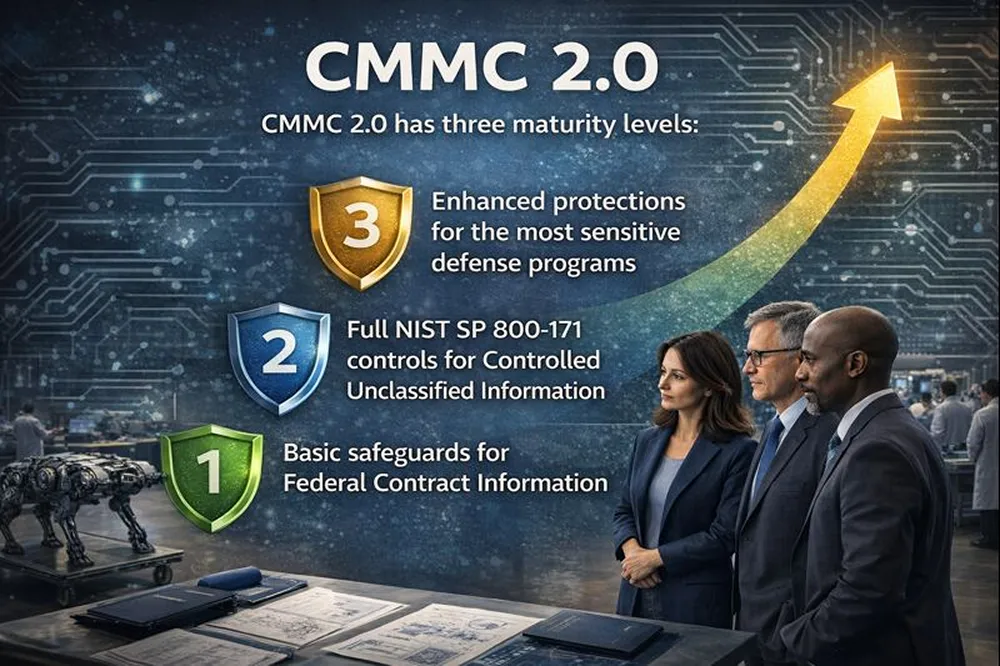
Understanding the three certification levels under CMMC 2.0 is essential for determining which level of CMMC compliance your organization needs and what specific security requirements you must implement. Each CMMC certification level corresponds to different types of information and risk profiles.

CMMC Level 1 represents foundational cybersecurity hygiene for organizations handling only Federal Contract Information (FCI). This level requires implementation of 17 basic security practices derived from FAR 52.204-21, covering fundamental protections like access controls, physical security, and system monitoring. Level 1 compliance involves annual self-assessments where contractors affirm their compliance without third-party verification, significantly reducing the cost of CMMC certification at this tier. Organizations working on contracts involving only FCI—basic administrative and financial information—typically need CMMC Level 1 certification.

CMMC Level 2 applies to contractors handling Controlled Unclassified Information (CUI), which includes technical data, export-controlled information, and operationally sensitive materials. This level of CMMC requires implementing all 110 security practices from NIST SP 800-171, covering 14 domain areas including access control, incident response, risk assessment, system integrity, and many others. Level 2 represents the most common CMMC requirement for defense contractors since most DoD contracts involve CUI processing or storage. CMMC Level 2 compliance requires triennial third-party assessments conducted by certified CMMC third-party assessment organizations for high-priority programs, while lower-priority programs may use annual self-assessments combined with senior official affirmation.

CMMC Level 3 addresses the most sensitive CUI requiring enhanced protection beyond standard NIST SP 800-171 requirements. This highest maturity level implements additional security controls from NIST SP 800-172, focusing on advanced persistent threats and sophisticated adversaries. Level 3 applies to a limited subset of highly sensitive programs involving critical technologies, advanced weapons systems, or intelligence activities. Organizations aiming for CMMC Level 3 must undergo rigorous government-led assessments rather than commercial third-party assessments, reflecting the critical nature of information protection at this tier.

The difference between CMMC levels isn't merely the number of security controls but the depth of implementation, documentation requirements, and assessment rigor. Higher levels build upon lower-level foundations, meaning Level 2 compliance includes all Level 1 requirements plus additional controls, and Level 3 encompasses both previous levels with enhanced protections. Understanding which certification level your contracts require is the critical first step in your CMMC compliance journey.

How Does the CMMC Assessment Process Actually Work?

The CMMC certification process differs significantly depending on your required CMMC level, but understanding the general assessment framework helps contractors prepare effectively and avoid costly mistakes during evaluation. The assessment methodology ensures consistent, objective evaluation of your cybersecurity posture against established standards.

For organizations seeking compliance with Level 1, the process involves conducting annual self-assessments using official CMMC assessment guides. Your internal team evaluates whether each of the 17 required practices is implemented and functioning as intended. You document your assessment results and provide an affirmation of compliance through the Department of Defense's Supplier Performance Risk System (SPRS) portal. While self-assessment reduces cost of CMMC compliance at Level 1, it still requires thorough documentation demonstrating that security controls are genuinely implemented rather than aspirational.

CMMC Level 2 compliance involves more rigorous evaluation, particularly for contracts designated as high-priority by DoD. For these priority programs, contractors must undergo triennial assessments by certified professionals from CMMC third-party assessment organizations accredited by the CMMC Accreditation Body. These independent assessors conduct comprehensive evaluations including documentation review, technical testing, personnel interviews, and facility inspections to verify that all 110 NIST SP 800-171 practices are properly implemented.

The third-party assessment typically begins with a readiness review where assessors evaluate your security documentation, policies, procedures, and system security plans. This initial phase identifies gaps and deficiencies before the formal assessment, allowing you to remediate issues proactively. The formal CMMC assessment then involves detailed examination of each security practice through multiple validation methods. Assessors review evidence, test technical controls, interview personnel about procedures, and inspect physical security measures to confirm comprehensive compliance.

For Level 2 contracts not designated as high-priority, CMMC 2.0 permits annual self-assessments combined with senior official affirmation—a middle-ground approach reducing assessment costs while maintaining accountability through executive-level attestation. However, many contractors still choose third-party assessment even when not required, recognizing that independent validation provides stronger assurance to customers and reduces risk of compliance challenges.

CMMC Level 3 assessments are conducted exclusively by Department of Defense assessors rather than commercial assessment organizations, reflecting the heightened sensitivity and criticality of protected information. These government-led evaluations apply the most stringent standards and occur at intervals determined by DoD based on program requirements and risk assessments.

Regardless of level, successful CMMC assessments require months of preparation, including gap analysis against CMMC requirements, remediation of identified deficiencies, development of comprehensive documentation, implementation of missing security controls, and staff training on cybersecurity procedures. Organizations should begin their compliance efforts well before contract deadlines to ensure adequate preparation time.

What Does CMMC Compliance Actually Cost and How Can You Budget Effectively?

The cost of CMMC certification varies dramatically based on multiple factors including your target certification level, current cybersecurity maturity, organizational size and complexity, existing security infrastructure, and whether you need significant technology investments or can leverage existing systems. Understanding these cost components helps contractors develop realistic budgets and avoid financial surprises.

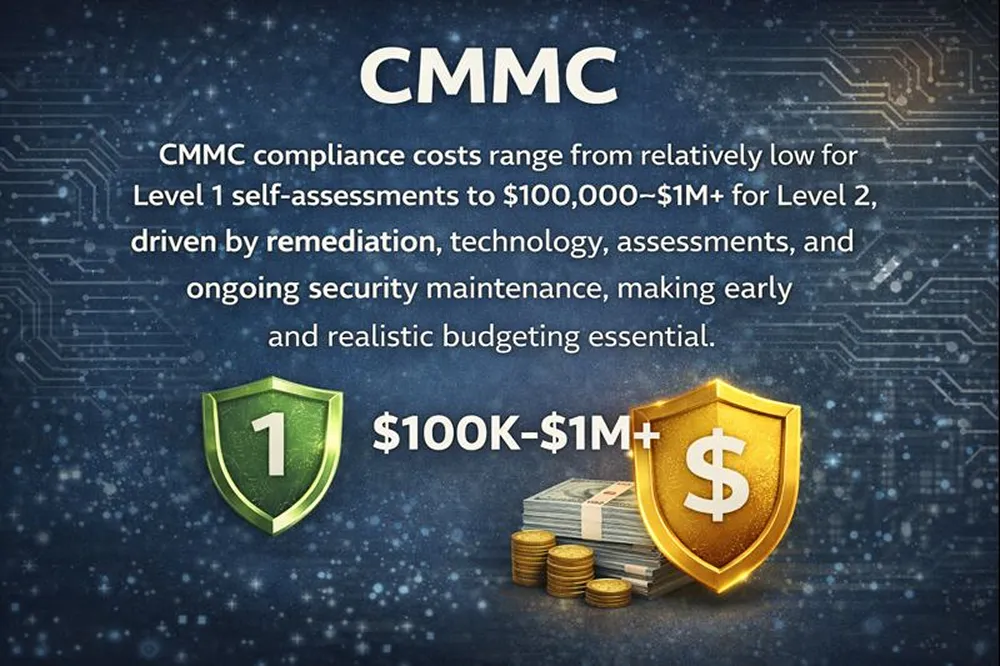
For CMMC Level 1, costs are relatively modest since self-assessment doesn't require third-party assessors. Most expenses involve staff time conducting the assessment, documentation development, and potential minor security enhancements to meet basic requirements. Small organizations might spend $5,000-$15,000 for consulting assistance and gap remediation, while many can achieve Level 1 compliance through internal resources if they already maintain reasonable cybersecurity practices.

CMMC Level 2 compliance represents a substantially larger investment due to the comprehensive scope of NIST SP 800-171 requirements and third-party assessment costs. The cost of CMMC compliance at Level 2 typically ranges from $100,000 to over $1 million depending on organizational factors. Key cost components include:

Gap assessment and remediation represent major expenses. Most contractors discover significant gaps between their current practices and CMMC requirements during initial assessments. Remediating these deficiencies—implementing missing security controls, upgrading systems, deploying new technologies—constitutes the largest portion of total compliance costs. Organizations starting with minimal cybersecurity infrastructure face substantially higher remediation expenses than those already implementing strong security programs.

Technology investments often include deploying multi-factor authentication systems, implementing endpoint detection and response tools, upgrading firewalls and intrusion detection systems, deploying encryption solutions for data at rest and in transit, implementing security information and event management (SIEM) platforms, and establishing secure backup and recovery capabilities. These technology costs can range from tens of thousands to hundreds of thousands of dollars depending on organizational size and existing infrastructure.

Documentation development requires creating comprehensive policies, procedures, system security plans, incident response plans, and evidence collection processes. Organizations can develop these internally or engage consultants, with consulting costs typically ranging from $20,000 to $100,000+ depending on scope and complexity.

Third-party assessment fees for CMMC Level 2 certification typically range from $15,000 to $50,000+ depending on organizational complexity, number of locations, system scope, and assessment organization pricing. These fees cover the actual certification audit conducted by the assessment organization.

Ongoing compliance costs must also be budgeted since achieving CMMC certification isn't a one-time event. Maintaining CMMC compliance requires continuous monitoring, regular security updates, periodic reassessments, staff training, and compliance management. Annual ongoing costs typically represent 20-30% of initial implementation expenses.

Consulting and preparation services help many contractors navigate the CMMC compliance process more efficiently. Expert consultants typically charge $150-$300+ per hour, with total engagement costs ranging from $30,000 to $200,000+ for comprehensive readiness programs depending on organizational needs.

For smaller contractors and subcontractors, these costs can seem prohibitive. However, consider that losing access to DoD contracts due to CMMC non-compliance represents a far greater financial impact than compliance investments. Additionally, achieving compliance often improves overall cybersecurity posture, reducing risk of costly data breaches and cyber incidents that could devastate organizations financially and reputationally.

How Can Organizations Prepare for and Achieve CMMC Compliance Efficiently?

Successfully navigating the CMMC compliance requirements demands a strategic, systematic approach rather than rushed, last-minute preparation. Organizations that plan carefully and execute methodically achieve certification more quickly, at lower cost, and with better long-term security outcomes than those taking reactive approaches.

Start with comprehensive gap analysis comparing your current cybersecurity practices against the CMMC framework requirements for your target level. This initial assessment identifies exactly what security controls are missing, which existing controls need strengthening, and what documentation requires development. Many organizations significantly underestimate their gaps during initial self-assessment, making professional gap analysis valuable for realistic planning. Understanding government procurement cycles helps you anticipate when CMMC requirements will impact your contract opportunities and plan preparation timelines accordingly.

Develop a detailed compliance roadmap prioritizing remediation activities based on risk, complexity, and resource requirements. Quick wins—simple controls you can implement rapidly—should be addressed early to demonstrate progress. More complex requirements involving significant technology deployment or process changes require longer timelines and careful project management. Your roadmap should include specific milestones, assigned responsibilities, resource allocations, and realistic completion dates.

Implement technical security controls systematically rather than haphazardly. Focus first on fundamental protections like access controls, multi-factor authentication, network segmentation, and encryption that provide broad security value beyond just CMMC compliance. Deploy monitoring and logging capabilities early so you can demonstrate continuous operation of security controls over time during assessments. Many CMMC requirements demand evidence of sustained implementation rather than simply installing technology shortly before assessment.

Develop comprehensive documentation since assessors will thoroughly review policies, procedures, system security plans, and operational evidence. Documentation must accurately reflect actual practices—assessors will test whether your documented procedures match operational reality. Many organizations fail assessments not because they lack security controls but because documentation doesn't adequately describe their implementation or evidence doesn't demonstrate sustained operation.

Establish a System Security Plan (SSP) that serves as your primary CMMC compliance document. The SSP describes your information systems, data flows, security boundaries, implemented controls, control implementation details, and assessment procedures. Developing a thorough, accurate SSP is essential for demonstrating compliance and provides assessors with a roadmap for evaluation.

Train personnel extensively on cybersecurity policies, procedures, and their individual responsibilities. CMMC assessments include interviewing staff to verify they understand and follow security procedures. Even perfect technical implementations fail if personnel don't know how to operate security controls properly or understand their compliance obligations.

Conduct internal readiness assessments using CMMC assessment guides before engaging official assessors. These practice evaluations identify remaining gaps, validate that controls function properly, and ensure evidence collection is adequate. Internal assessments significantly increase success rates during formal evaluations by allowing you to address issues proactively.

Engage qualified consultants strategically if you lack internal expertise for complex requirements. Consultants can accelerate your compliance process, help avoid common pitfalls, provide objective gap assessments, and assist with documentation development. However, ensure consultants transfer knowledge to your team rather than simply doing the work for you—you must understand and maintain your security program long-term.

Plan for continuous compliance rather than treating CMMC as a one-time project. Implementing processes for ongoing security monitoring, regular control validation, incident response, change management, and periodic reassessment ensures you maintain certification and avoid compliance lapses that could jeopardize contract eligibility.

What Are Common CMMC Compliance Mistakes and How Can You Avoid Them?

Many defense contractors encounter preventable obstacles during their CMMC compliance journey due to common misconceptions and strategic errors. Understanding these frequent mistakes helps organizations avoid costly delays, failed assessments, and wasted resources.

Mistake 1: Waiting until contract requirements mandate CMMC. Many contractors delay compliance efforts until specific solicitations require certification, leaving inadequate preparation time. Since achieving CMMC compliance typically requires 6-18 months depending on organizational readiness, starting early is essential. Proactive preparation prevents rushed implementations that miss critical requirements and positions you competitively for contracts as CMMC requirements expand.

Mistake 2: Underestimating scope and complexity. Contractors frequently assume CMMC compliance involves simple IT upgrades rather than comprehensive organizational transformation affecting policies, procedures, personnel training, physical security, and operational practices across the entire organization. This underestimation leads to inadequate budgeting, unrealistic timelines, and compliance failures when assessments reveal extensive gaps.

Mistake 3: Focusing exclusively on technology while neglecting policies and procedures. While technical security controls are important, CMMC equally emphasizes documented policies, operational procedures, and evidence of consistent implementation. Organizations investing heavily in technology while maintaining inadequate documentation or inconsistent procedures fail assessments despite sophisticated technical capabilities.

Mistake 4: Attempting complete self-implementation without expert guidance. While some organizations successfully achieve CMMC compliance internally, most benefit significantly from expert consulting, particularly for gap assessment, complex technical requirements, and documentation development. Trying to save consulting costs often results in failed assessments requiring expensive remediation and reassessment.

Mistake 5: Treating CMMC as purely an IT responsibility. Effective CMMC compliance requires engagement from leadership, procurement, legal, operations, facilities, HR, and other departments beyond just IT. Cybersecurity is an enterprise responsibility, and organizations that isolate compliance efforts within IT departments struggle to implement controls requiring cross-functional coordination.

Mistake 6: Failing to scope systems appropriately. CMMC allows organizations to define specific system boundaries where CUI is processed, stored, or transmitted rather than certifying entire corporate networks. However, many contractors fail to properly scope their CMMC environment, either including unnecessary systems that increase complexity and cost, or excluding necessary systems that create compliance gaps. Effective scoping requires careful analysis of data flows, business processes, and security boundaries.

Mistake 7: Inadequate evidence collection and retention. CMMC assessments require demonstrating sustained implementation of security controls over time, not just current capability. Organizations that fail to collect, organize, and retain compliance evidence struggle during assessments when assessors request proof of continuous operation. Implementing evidence collection processes early in your compliance journey ensures adequate documentation when assessment occurs.

Mistake 8: Ignoring supply chain and service provider requirements. CMMC compliance extends to external service providers and subcontractors who handle CUI on your behalf. Many organizations overlook this flow-down requirement, failing to ensure their cloud providers, managed service providers, and subcontractors maintain appropriate CMMC compliance levels. This oversight creates compliance gaps that assessors will identify.

How Will CMMC 2.0 Be Required and What Is the Implementation Timeline?

Understanding when CMMC compliance will be required for DoD contracts helps contractors prioritize preparation efforts and avoid contract eligibility issues. The implementation timeline has evolved significantly since initial CMMC program announcements, with CMMC 2.0 representing a more measured, phased approach than originally planned.

The CMMC program rule underwent extensive regulatory development and public comment periods before finalization. The Department of Defense published the proposed CMMC rule in December 2023, solicited public feedback, and worked toward final rule publication. Once the final CMMC rule is published in the Federal Register, a six-month implementation period allows contractors to prepare before CMMC requirements begin appearing in solicitations.

The phased implementation approach means CMMC requirements won't immediately apply to all DoD contracts simultaneously. Instead, requiring compliance will occur gradually, beginning with contracts involving the most sensitive information and highest-priority programs. Defense contractors should monitor specific solicitations for CMMC requirements rather than assuming all DoD contracts immediately mandate certification.

For prime contractors on major defense programs, CMMC requirements are likely to appear relatively quickly once implementation begins. However, flow-down to subcontractors at lower supply chain tiers will occur more gradually as prime contractors incorporate CMMC compliance requirements into subcontract terms. Organizations deep in the supply chain may have additional time before certification becomes mandatory, though proactive preparation remains advisable.

The Department of Defense has emphasized that CMMC 2.0 permits flexibility in assessment approaches based on program sensitivity and risk. High-priority acquisitions involving critical technologies will require third-party assessment sooner, while lower-priority programs may initially accept self-assessments. This risk-based approach allows DoD to focus rigorous verification on the most sensitive contracts while avoiding overwhelming the assessment ecosystem with excessive demand.

Contractors should actively track CMMC implementation through official DoD sources including the Office of the Under Secretary of Defense for Acquisition & Sustainment, the Defense Procurement and Acquisition Policy office, and official CMMC resources at acq.osd.mil/cmmc. These authoritative sources provide current information as implementation progresses and requirements develop.

Organizations should not wait for formal CMMC requirements in specific solicitations before beginning preparation. The lead time required to achieve CMMC compliance means that contractors starting preparation only when solicitations mandate certification will likely miss contract opportunities. Starting preparation now positions your organization advantageously regardless of exact implementation dates.

What Resources and Support Are Available for CMMC Compliance?

Navigating CMMC compliance requirements doesn't require organizations to work in isolation. Numerous resources, tools, and support options help contractors achieve certification more efficiently and cost-effectively than attempting completely independent implementation.

The CMMC Accreditation Body serves as the official source for CMMC program information, authorized assessment organizations, certified assessor listings, and compliance guidance. Their website provides authoritative information on CMMC requirements, assessment procedures, and program updates. Contractors should regularly consult this resource to ensure they're working with accurate, current information rather than outdated guidance from CMMC 1.0.

The National Institute of Standards and Technology (NIST) publishes the foundational security standards underlying CMMC Level 2 and Level 3 requirements. NIST SP 800-171 provides detailed guidance on each security requirement, implementation approaches, and assessment procedures. NIST resources include implementation guides, assessment methodologies, and supporting documentation that clarifies compliance expectations.

The DoD Cybersecurity Resource Center offers extensive information specifically for defense contractors navigating cybersecurity requirements. Resources include compliance guides, frequently asked questions, policy documents, and links to relevant regulations affecting DoD contractors.

Professional associations like the National Defense Industrial Association (NDIA) provide CMMC-focused events, working groups, and educational resources connecting contractors with peers facing similar compliance challenges. These industry forums facilitate knowledge sharing, lessons learned, and collaborative problem-solving that benefits the entire defense industrial base.

Many contractors benefit from engaging CMMC consultants and managed security service providers who specialize in defense contractor compliance. These experts provide services ranging from gap assessments and compliance roadmap development to full-service implementation support and ongoing compliance management. When selecting consultants, verify their credentials, request references from similar organizations, and ensure they transfer knowledge to your internal team rather than creating dependency.

For organizations developing winning strategies for government RFP responses that must address CMMC requirements, understanding how to articulate your compliance status and security capabilities is essential. Similarly, mastering government proposal writing includes effectively communicating your cybersecurity maturity to evaluators assessing contractor capabilities.

Technology vendors increasingly offer CMMC-focused solutions designed specifically for defense contractor compliance. These purpose-built platforms can simplify implementation of specific CMMC requirements, though contractors should carefully evaluate whether vendor solutions genuinely meet requirements or simply market themselves using CMMC terminology without substantive compliance value.

If you need personalized guidance navigating CMMC compliance requirements, developing an effective implementation strategy, or understanding how CMMC impacts your specific contracts and business model, contact experienced advisors who can provide tailored support for your organization's unique situation.

Key Takeaways: Essential Points About CMMC Compliance

Understanding CMMC Fundamentals:

  • The Cybersecurity Maturity Model Certification (CMMC) is the Department of Defense's unified cybersecurity standard requiring defense contractors to implement verified security controls protecting sensitive information throughout the defense supply chain
  • CMMC 2.0 streamlined the framework to three levels of maturity: Level 1 for Federal Contract Information with basic protections, Level 2 for Controlled Unclassified Information implementing NIST SP 800-171, and Level 3 for the most sensitive CUI requiring enhanced protection
  • Unlike previous self-assessment approaches, CMMC compliance requires independent verification through third-party assessments for higher-risk contracts, ensuring actual implementation rather than self-attestation
  • CMMC requirements will become mandatory for DoD contracts through phased implementation, making certification essential for contractors seeking to maintain defense contracting eligibility

Assessment and Certification Process:

  • CMMC Level 1 requires annual self-assessments implementing 17 basic security practices from FAR 52.204-21, with contractor affirmation of compliance without third-party verification
  • CMMC Level 2 compliance demands implementing all 110 NIST SP 800-171 practices, with high-priority programs requiring triennial third-party assessment by certified CMMC assessment organizations and lower-priority programs permitting self-assessment with senior official affirmation
  • CMMC Level 3 involves government-led assessments implementing advanced security controls from NIST SP 800-172 for the most sensitive programs involving critical technologies and advanced weapons systems
  • Successful assessments require comprehensive preparation including gap analysis, security control implementation, extensive documentation development, evidence collection, personnel training, and internal readiness evaluations before formal certification

Cost Considerations and Budgeting:

  • The cost of CMMC certification varies dramatically from $5,000-$15,000 for Level 1 self-assessment to $100,000-$1,000,000+ for Level 2 compliance depending on organizational size, current security maturity, and required remediation
  • Major cost components include gap remediation, technology investments in security tools and infrastructure, documentation development, third-party assessment fees, consulting services, and ongoing compliance management
  • Organizations should budget for continuous compliance costs representing 20-30% of initial implementation expenses annually, as CMMC requires sustained security program operation rather than one-time certification
  • Despite potentially significant costs, CMMC compliance investment is substantially less expensive than losing access to DoD contracts or experiencing costly data breaches from inadequate cybersecurity

Strategic Success Factors:

  • Begin CMMC compliance preparation immediately rather than waiting for specific contract requirements, as achieving certification typically requires 6-18 months of systematic implementation effort
  • Conduct thorough gap analysis, develop detailed compliance roadmaps, implement technical controls systematically, create comprehensive documentation, train personnel extensively, and establish continuous compliance processes
  • Avoid common mistakes including underestimating complexity, focusing exclusively on technology while neglecting policies and documentation, treating compliance as purely IT responsibility, and inadequate evidence collection
  • Leverage available resources including the CMMC Accreditation Body, NIST guidance, DoD resources, professional associations, qualified consultants, and purpose-built compliance technologies to accelerate your CMMC compliance journey

The Cybersecurity Maturity Model Certification represents a fundamental transformation in defense contractor cybersecurity requirements, moving from voluntary self-assessment to mandatory verified compliance. Organizations that approach CMMC compliance strategically—beginning preparation early, implementing comprehensive security programs, developing thorough documentation, and establishing sustainable compliance processes—will achieve certification efficiently while strengthening their overall cybersecurity posture, competitive position, and long-term viability in the defense industrial base.

Other Blogs

OryonIQ Events

Events

Are you curious about the networking events near you? Together we can expand your network and watch your pipeline exponentially grow.