InstagramFacebookLinkedinMediumYoutubeX
Oryon iq

B2G Marketing Strategies: Winning Government Contracts Through Strategic Brand Visibility

The Business-to-Government (B2G) market represents one of the most lucrative yet challenging sectors for companies seeking sustainable growth and long-term partnerships. Unlike traditional B2B sales, winning government contracts requires specialized marketing strategies that resonate with government buyers, navigate complex procurement processes, and demonstrate your expertise through every stage of the contract lifecycle. Federal, state, and local government agencies spend hundreds of billions of dollars annually on products and professional services, creating enormous opportunities for contractors seeking to grow within the federal government marketplace. However, success in B2G marketing demands more than quality offerings—it requires understanding the government procurement mindset, building the relationships with key decision-makers, and developing targeted marketing approaches that align with government requirements and timelines. This comprehensive guide explores proven B2G marketing strategies that help companies increase brand visibility, optimize their business development efforts, and ultimately win more government contracts in this unique and rewarding marketplace.

What Makes B2G Marketing Different from Traditional B2B?

B2G marketing fundamentally differs from traditional B2B approaches in ways that profoundly impact strategy and execution. Government buyers operate under strict regulations, formal procurement rules, and public accountability requirements that shape every aspect of how they evaluate solutions and select contractors. Understanding these distinctions is essential for developing effective B2G marketing campaigns.

The procurement processes in government contracting follow rigid structures governed by regulations like the Federal Acquisition Regulation (FAR). Unlike B2B sales where purchasing decisions may happen quickly through informal negotiations, government procurement involves publicized solicitations, structured evaluation criteria, and documented decision-making processes. This formality means that marketing efforts must focus on building credibility and visibility long before specific opportunities emerge, positioning your company as a known and trusted solution provider when buyers begin their formal procurement activities.

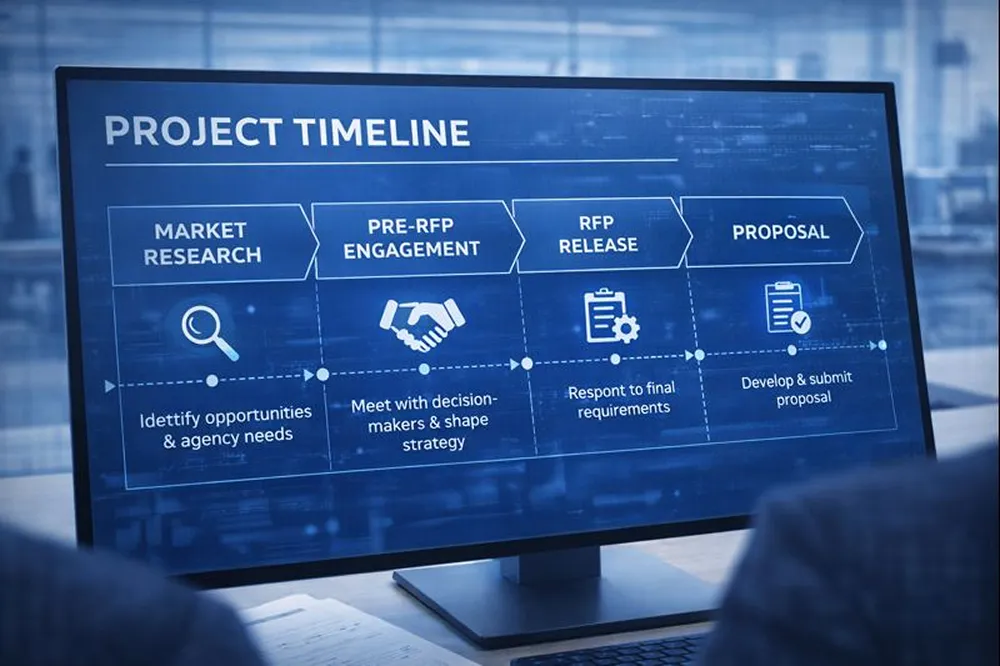
The decision-making timeline in B2G sales cycles extends far beyond typical B2B transactions. From initial market research through contract award can span months or even years, requiring patience and sustained engagement. Government buyers often conduct extensive due diligence, require multiple levels of approval, and face budget constraints tied to fiscal year cycles. Your marketing strategies must account for these extended timelines, maintaining consistent visibility and engagement throughout long sales cycles. Resources like understanding the government procurement cycle provide critical context for timing your marketing investments.

Additionally, unlike B2B where relationships and personal connections heavily influence purchasing, government procurement emphasizes documented past performance, compliance credentials, and objective evaluation criteria. While relationships certainly matter in federal contracting, they function differently—government decision-makers need defensible rationale for their selections, meaning your brand must clearly communicate capabilities, experience, and value through verifiable evidence rather than persuasive sales pitches alone.

How Do You Build Brand Visibility in the Federal B2G Marketplace?

Establishing strong brand visibility in the federal marketplace requires strategic, sustained efforts across multiple channels that government audiences actually use. Unlike consumer or B2B markets where social media and digital advertising dominate, government buyers rely heavily on specific platforms, industry events, and professional networks.

Registration in the System for Award Management (SAM) represents the foundational step for any contractor seeking federal opportunities. SAM serves as the official database where government buyers search for potential vendors, making your company profile essentially your storefront in the federal marketplace. Beyond basic registration, optimize your SAM profile with comprehensive capability statements, detailed product and service descriptions, and relevant socioeconomic certifications. Many contracting officers use SAM as their primary tool for market research, meaning a well-crafted profile directly impacts your visibility to federal buyers.

Industry conferences and government-sponsored events provide unparalleled opportunities for brand building in the B2G market. Events like the AFCEA conferences, National Contract Management Association meetings, and agency-specific industry days allow contractors to meet government decision-makers face-to-face, demonstrate their expertise, and build the relationships that support future contract awards. Unlike B2B trade shows focused on immediate sales, these government-focused events emphasize education, networking, and long-term partnership development. Active participation through speaking engagements, booth presence, or sponsorships dramatically increases your brand recognition among the government audiences that matter most.

Thought leadership content specifically tailored to government challenges establishes your organization as a subject matter expert. Publishing white papers addressing agency pain points, contributing articles to government-focused publications like GovCon Wire or Federal News Network, and presenting at industry forums positions your brand as a knowledgeable partner rather than just another vendor. Government buyers value contractors who understand their missions and can provide insights beyond basic product or service capabilities.

What Role Does Past Performance Play in B2G Marketing?

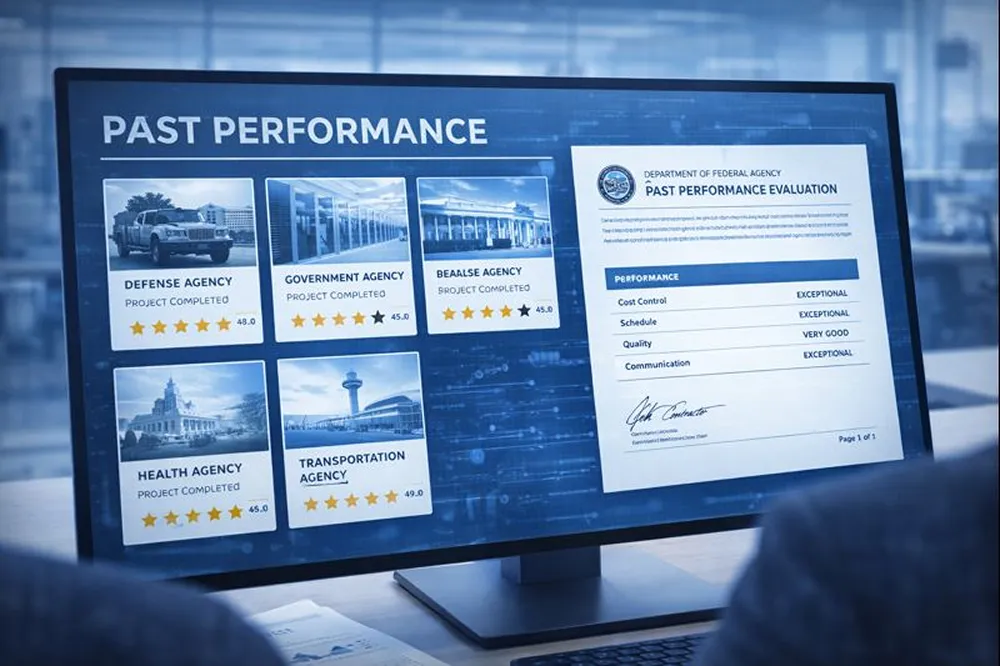
Past performance represents perhaps the single most powerful marketing asset in government contracting. Federal buyers heavily weight contractor track records when evaluating proposals, often making past performance the determining factor between similarly qualified bidders. Your marketing strategies must prominently showcase successful government projects and satisfied agency customers.

The Contractor Performance Assessment Reporting System (CPARS) serves as the official repository for federal contractor performance evaluations. Strong CPARS ratings become powerful marketing tools, providing objective third-party validation of your ability to deliver quality work on time and within budget. Smart B2G marketing strategies prominently feature these ratings in capability statements, proposals, and business development conversations. Actively managing your CPARS ratings—ensuring contracting officers complete evaluations and addressing any concerns promptly—protects and enhances this critical marketing asset.

Case studies specifically documenting government successes provide compelling evidence of your capabilities to potential buyers. Unlike B2B case studies that might emphasize innovation or cost savings, government-focused case studies should highlight compliance with requirements, successful navigation of complex procurement processes, and mission impact. Detail the specific agency requirements you addressed, challenges you overcame, and measurable outcomes you achieved. These narratives help government buyers visualize how your solutions apply to their situations, reducing perceived risk associated with selecting your company.

Building a portfolio of contract vehicles and past awards creates momentum in the federal marketplace. Government buyers prefer working with contractors who have already been vetted by other agencies, viewing prior contract awards as de facto endorsements. This dynamic means your first government contract often proves the most difficult to secure, but subsequent opportunities become progressively easier as your past performance portfolio grows. Marketing should emphasize not just individual projects but the breadth of your government experience, demonstrating you're an established federal contractor rather than a newcomer to the B2G market. Learning winning strategies for government RFP responses helps convert visibility into actual contract awards.

How Can You Effectively Target Government Decision-Makers?

Reaching the right government decision-makers requires understanding the multi-layered nature of federal procurement organizations and developing targeted marketing approaches for different stakeholder groups. Successful B2G sales involve engaging program managers who define requirements, contracting officers who manage the acquisition process, technical evaluators who assess solutions, and end users who will actually use your products or services.

Market intelligence gathering forms the foundation of targeted marketing in government contracting. Identify which agencies use solutions similar to yours, track upcoming recompetes of existing contracts, monitor budget allocations and strategic priorities, and understand agency organizational structures. Tools like GovWin IQ and SAM.gov provide searchable databases of government opportunities, spending patterns, and agency contacts. This data-driven approach allows you to focus business development resources on the most promising opportunities rather than pursuing every possible lead. Resources like tools to find government contract bid and RFP opportunities help contractors identify and track relevant opportunities.

Direct engagement with contracting officers and program managers through one-on-one meetings yields valuable insights that inform your marketing strategies. Request capability briefings where you present your solutions, ask questions about upcoming requirements, and gather feedback on how well your offerings align with agency needs. These meetings shouldn't feel like sales calls—instead, position them as educational sessions helping government buyers understand available solutions and market capabilities. The relationships built through these interactions create name recognition that proves invaluable when agencies issue solicitations.

Teaming arrangements and partnership strategies expand your reach within the federal marketplace. Many prime contractors maintain preferred vendor lists and actively seek qualified subcontractors for specific capabilities. Marketing yourself to established government contractors can provide entry into opportunities you couldn't pursue independently. Conversely, if you're a larger company, developing a network of small business partners helps you meet socioeconomic contracting goals while expanding your technical capabilities. These partnership arrangements essentially multiply your marketing presence across the federal landscape.

What Content Marketing Approaches Work in the B2G Market?

Content marketing in the B2G marketplace differs significantly from consumer or B2B approaches, requiring focus on education, compliance, and mission alignment rather than traditional sales messaging. Government audiences value substantive information that helps them understand solutions, evaluate options, and justify decisions.

White papers addressing specific agency challenges demonstrate your expertise while providing genuine value to government buyers. Topics might include emerging technology applications in government, cybersecurity best practices for federal agencies, strategies for modernizing legacy systems, or approaches to meeting regulatory compliance requirements. These documents shouldn't read like marketing brochures—instead, they should offer actionable insights, industry analysis, and practical recommendations that decision-makers can use regardless of whether they ultimately select your company. This generosity builds trust and positions your brand as a thought leader.

Capability statements serve as essential marketing tools specifically designed for government audiences. Unlike corporate brochures targeting B2B buyers, capability statements follow a standardized format that government contracting offices expect. They should clearly articulate your core competencies, relevant past performance, differentiators, socioeconomic certifications, and contact information—all condensed into one or two pages. Develop versions tailored to different agency types or service areas, ensuring each capability statement speaks directly to the recipient's specific requirements. Effective capability statements become leave-behind materials after meetings and attachments to introductory emails that open doors with new agencies.

Webinars and virtual events focused on government-relevant topics provide scalable ways to reach government audiences while demonstrating your expertise. Topics aligned with current federal priorities—such as zero trust architecture, cloud migration, or workforce modernization—attract government attendees interested in learning about solutions. These educational sessions build awareness, generate leads, and create opportunities for follow-up conversations. Recording webinars extends their value, creating evergreen content you can share through multiple channels and use in nurture campaigns. Understanding proposal writing strategies helps convert content marketing engagement into successful bids.

How Do You Capture Strategies Support B2G Marketing Success?

Capture strategies represent the operational bridge between marketing activities and actual contract wins, providing structured approaches to pursuing specific opportunities throughout the contract lifecycle. While marketing builds broad awareness and credibility, capture management focuses resources on the most promising opportunities with the highest probability of success.

Early engagement long before solicitation release characterizes successful capture strategies. By the time an RFP appears on SAM.gov, many aspects of the acquisition have already been determined—requirements defined, budgets allocated, and incumbent relationships established. Effective capture begins months or years earlier, when contractors engage agencies during their planning phases. Marketing activities that create visibility and relationships enable these early capture conversations where you can influence requirements, understand evaluation priorities, and position your solutions favorably.

Opportunity qualification ensures marketing investments yield actual revenue rather than just activity metrics. Not every government opportunity deserves pursuit—some have low win probability, unfavorable requirements, or insufficient profit potential. Rigorous qualification criteria might include: Do we have relevant past performance? Can we meet technical requirements? Do we have relationships with key decision-makers? Is the competitive landscape favorable? Does the opportunity align with strategic priorities? Marketing should generate qualified leads that meet these criteria rather than pursuing volume for its own sake, optimizing your capture strategies for actual results.

Bid/no-bid decisions represent critical junctures where marketing insights inform business judgment. Your marketing efforts should generate the market intelligence needed for informed decisions—understanding competitor strengths and weaknesses, knowing customer preferences and priorities, assessing relationship strength with the buyer, and recognizing whether the opportunity truly fits your capabilities. Companies that win government contracts consistently make disciplined bid decisions, pursuing opportunities where they have genuine advantages rather than submitting proposals for every visible opportunity.

What Digital Marketing Tactics Work for B2G Companies?

While government buyers may seem resistant to modern digital marketing, strategic use of digital channels can significantly enhance B2G marketing effectiveness. The key lies in understanding which digital tactics resonate with government audiences and how to deploy them appropriately.

Search engine optimization targeting government-specific keywords helps contractors seeking federal business find your company during their research phase. Government buyers regularly use search engines to identify potential solutions and research vendors before formal procurement begins. Optimizing your website for terms like "federal cybersecurity solutions," "DOD cloud services contractor," or "healthcare IT for government agencies" ensures your company appears in these critical research moments. Technical SEO fundamentals apply, but keyword strategy must focus on government-specific terminology and agency names rather than generic B2B terms.

LinkedIn represents the most valuable social media platform for B2G marketing, as many government decision-makers maintain professional profiles and engage with content. Share thought leadership articles, announce contract awards (when permitted), highlight team expertise, and participate in government-focused groups. Unlike consumer social media where viral content reigns, B2G social media success comes through consistent, professional engagement that reinforces your brand positioning. Connect with contracting officers, program managers, and industry peers to expand your network and increase content reach within government circles.

Email marketing campaigns targeted to government audiences require careful compliance with regulations and respect for official communication preferences. Building permission-based email lists through event registrations, webinar attendance, and whitepaper downloads creates audiences for ongoing nurture campaigns. Content should educate rather than sell, providing valuable information about industry trends, regulatory changes, or technical innovations. Segmenting lists by agency type, role, or interest area allows for personalized messaging that feels relevant rather than generic spam. Remember that government email systems often block external messages, so also maintain personal email contacts when appropriate.

How Important Are Certifications and Compliance in B2G Marketing?

Certifications and compliance credentials function as essential marketing differentiators in government contracting, often determining whether contractors can even compete for certain opportunities. Your marketing strategies must prominently feature relevant certifications while maintaining the underlying compliance that makes those credentials meaningful.

Small business certifications create access to set-aside opportunities where competition is limited to certified companies. The Small Business Administration (SBA) offers various programs including 8(a) Business Development for disadvantaged businesses, HUBZone for companies in historically underutilized business zones, Women-Owned Small Business (WOSB), and Service-Disabled Veteran-Owned Small Business (SDVOSB). Federal agencies face mandates to award certain percentages of contracting dollars to these categories, making relevant certifications powerful marketing advantages. Prominently display your certifications in capability statements, proposals, email signatures, and website headers—they're not just nice-to-have credentials but fundamental qualifications that unlock opportunities.

Industry-specific certifications demonstrate technical credibility and commitment to professional standards. Depending on your sector, relevant certifications might include Cybersecurity Maturity Model Certification (CMMC) for defense contractors, ISO certifications for quality management, or professional credentials for key personnel. Government buyers view these certifications as independent validation of your capabilities, reducing their perceived risk in selecting your company. Marketing should explain what these certifications mean and why they matter, helping buyers understand the value they represent.

Contract vehicles and past awards themselves function as powerful marketing credentials in the B2G marketplace. Holding a GSA Schedule essentially pre-qualifies your company for streamlined purchasing by federal agencies, making GSA Schedule status a significant marketing advantage. Similarly, being approved for Government-Wide Acquisition Contracts (GWACs) or agency-specific contract vehicles demonstrates that your company has survived rigorous vetting. These vehicles streamline the procurement process for buyers, making your solutions more accessible and attractive compared to competitors requiring full and open competition. Leverage these credentials throughout your sales and marketing materials, emphasizing the purchasing ease they provide government buyers.

How Can You Measure B2G Marketing ROI and Optimize Performance?

Measuring marketing effectiveness in the B2G market presents unique challenges compared to B2B environments where digital attribution and pipeline metrics are well-established. However, tracking the right indicators enables continuous improvement and justification of marketing investments.

Pipeline metrics adapted for long government sales cycles provide leading indicators of marketing success. Track metrics including: number of qualified opportunities identified, total value of opportunities in pipeline, number of agency relationships established, capability briefings conducted, and proposal submissions. Because government procurement cycles extend so long, these leading indicators reveal whether marketing activities are generating future revenue opportunities even before contracts are awarded. Establish baseline metrics and set targets for improvement across these dimensions.

Win rate analysis by opportunity type reveals where your marketing and business development efforts yield the best returns. Calculate separate win rates for different contract types (new business versus recompetes, prime versus subcontract, competed versus sole-source), agency categories (DOD versus civilian, federal versus state/local), and contract values. This analysis helps you understand where you're most competitive and should focus resources. Low win rates in certain categories might indicate need for improved marketing and capture strategies in those areas, or suggest you should redirect efforts toward more promising market segments.

Cost per win and customer acquisition costs provide financial metrics assessing marketing efficiency. Calculate the total cost of marketing and business development activities divided by the number of contracts won to understand how much investment is required to secure government business. Compare this to contract values and profit margins to ensure sustainable growth. Track these metrics over time to assess whether improvements in marketing effectiveness are reducing acquisition costs while maintaining or increasing win rates. This data-driven approach to B2G marketing ensures accountability and supports informed decisions about resource allocation across marketing tactics and market segments.

What Role Do Partnerships Play in B2G Market Success?

Strategic partnerships and teaming arrangements amplify B2G marketing effectiveness while expanding market access and technical capabilities. The complexity and size of many government contracts mean that few companies can succeed entirely independently—collaboration becomes both necessary and strategic.

Prime-subcontractor relationships provide market access for companies not yet positioned to pursue opportunities independently. If you're a small or newer government contractor, partnering with established primes allows you to gain past performance, build agency relationships, and learn federal contracting processes while contributing your technical expertise. Marketing yourself effectively to potential prime contractors requires different messaging than selling directly to government—emphasize your specialized capabilities, past performance in your niche, cultural fit, and reliability. Building relationships with primes' business development teams opens doors to opportunities you'd never discover through your own prospecting efforts.

Joint ventures and teaming arrangements for specific opportunities combine complementary capabilities to pursue contracts beyond what any single company could address independently. Government buyers increasingly package requirements into larger, more comprehensive contracts favoring contractors who can provide complete solutions. Strategic teaming allows you to offer full-scope capabilities while maintaining focus on your core competencies. Marketing these partnerships requires clearly communicating each partner's role, demonstrating the team's collective experience, and showing how the partnership creates value beyond what individual companies could deliver separately.

Mentor-protégé relationships formalized through SBA programs create structured partnerships benefiting both parties. Established contractors gain access to small business set-asides by mentoring and teaming with protégé companies, while small businesses receive guidance, past performance opportunities, and business development support from experienced mentors. These arrangements combine the agility and innovation often found in smaller companies with the resources and experience of larger firms. Marketing mentor-protégé teams emphasizes the unique advantages this structure provides government buyers, positioning the relationship as a strategic asset rather than a simple teaming arrangement.

Key Takeaways: Essential B2G Marketing Strategies

  • Government procurement differs fundamentally from B2B: Long sales cycles, formal procurement processes, and strict evaluation criteria require specialized marketing approaches rather than traditional B2B tactics
  • Past performance is your strongest marketing asset: Document successful projects, maintain strong CPARS ratings, and prominently feature government experience in all marketing materials and proposals
  • Early engagement is critical: Start building relationships and influencing requirements long before RFPs are released, as many decisions are effectively made during the planning phase
  • Targeted marketing outperforms broad approaches: Focus business development resources on agencies and opportunities where you have competitive advantages rather than pursuing every visible opportunity
  • Content marketing builds credibility: White papers, case studies, and thought leadership tailored to government challenges establish your expertise and differentiate your brand
  • Certifications unlock opportunities: Small business certifications, industry credentials, and contract vehicles create competitive advantages and access to set-aside opportunities
  • Digital channels matter: Strategic use of SEO, LinkedIn, and email marketing increases visibility among government buyers conducting research before formal procurement begins
  • Capture strategies bridge marketing and sales: Systematic approaches to pursuing specific opportunities ensure marketing generates actual revenue rather than just awareness
  • Partnerships expand market access: Strategic teaming with primes, joint ventures, and mentor-protégé relationships allow you to pursue opportunities beyond your independent capabilities
  • Measurement enables optimization: Track pipeline metrics, win rates, and cost per acquisition to assess marketing effectiveness and continuously improve performance in the federal marketplace

Success in B2G marketing requires patience, persistence, and specialized knowledge of how government procurement works. Unlike traditional B2B where relationships and persuasive sales tactics often drive decisions, winning government contracts demands demonstrated capability, documented past performance, and strategic positioning long before opportunities emerge. Companies that invest in building brand visibility, establishing relationships with key decision-makers, and developing the credibility that resonates with government buyers position themselves for sustainable growth throughout the contract lifecycle.

Ready to transform your B2G marketing strategy and win more government contracts? Contact our team to discuss how we can help you succeed in the government marketplace with proven strategies and expert guidance.

Other Blogs

OryonIQ Events

Events

Are you curious about the networking events near you? Together we can expand your network and watch your pipeline exponentially grow.