Controlled Unclassified Information (CUI) represents a critical framework that governs how sensitive government information is handled, marked, and protected across federal agencies and contractor organizations. Established through Executive Order 13556 and implemented via 32 CFR Part 2002, the CUI program standardizes the way the government creates, safeguards, and disseminates information that requires safeguarding or dissemination controls pursuant to and consistent with applicable law, regulations, and government-wide policies. Understanding CUI is essential for anyone working with federal information systems, particularly Department of Defense (DOD) contractors who regularly handle sensitive data. This comprehensive guide explains what qualifies as CUI, how to identify and mark it correctly, the differences between CUI Basic and CUI Specified, and the practical requirements for protecting controlled unclassified information in both federal and nonfederal systems and organizations.
Controlled Unclassified Information is federal information the government creates or possesses, or an entity creates or possesses on behalf of the government, that requires safeguarding or dissemination controls pursuant to and consistent with applicable law, regulations, and government-wide policies. The term does not include classified information or information that is lawfully publicly available.
The CUI program emerged from a need to standardize how federal agencies handle sensitive information that doesn't meet the threshold for classification but still requires protection. Before the CUI framework, agencies used inconsistent markings and handling procedures—terms like "For Official Use Only," "Sensitive But Unclassified," and dozens of other agency-specific labels created confusion and security gaps. Executive Order 13556, issued in 2010, established a unified approach managed by the National Archives and Records Administration (NARA) through the Information Security Oversight Office (ISOO).
For contractors and organizations working with federal agencies, understanding CUI is not optional—it's mandatory. Contracts involving CUI require specific safeguarding measures, personnel training, and system certifications. Failure to properly protect CUI can result in contract termination, legal liability, and loss of future government opportunities. The DOD, in particular, has stringent requirements for protecting controlled unclassified information, including the Cybersecurity Maturity Model Certification (CMMC) framework that contractors must achieve to handle CUI on behalf of the government.
Identifying CUI requires understanding both the CUI Registry and the context in which information is created or received. The CUI Registry, maintained by NARA, provides the authoritative source listing all approved CUI categories and the laws, regulations, or government-wide policies that require or permit agencies to control the information.
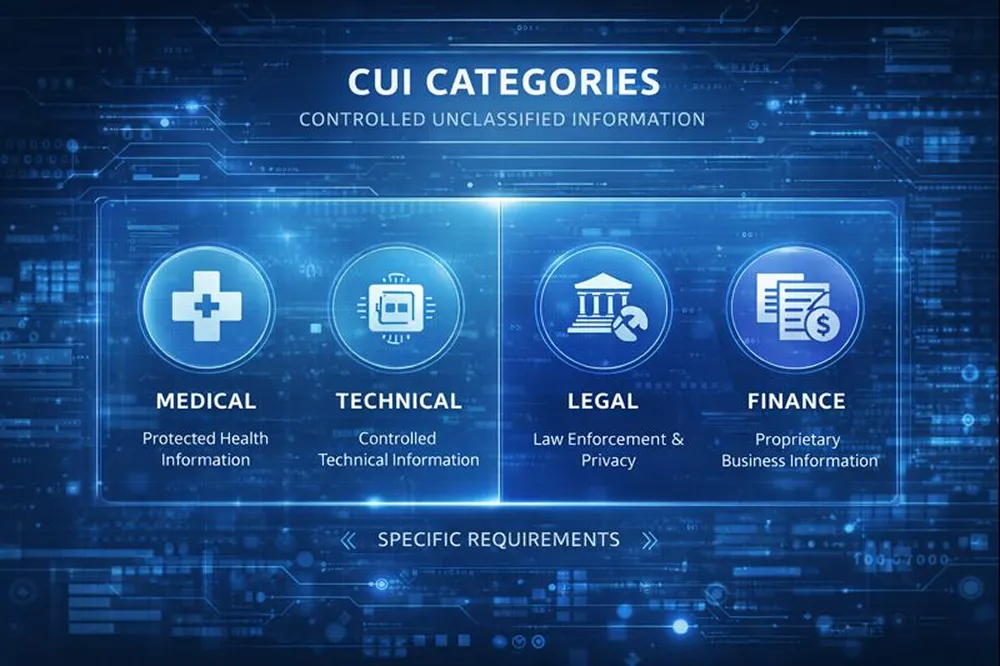
The CUI Registry organizes controlled unclassified information into distinct CUI categories based on the subject matter and authorizing authority. Currently, there are approximately 20 major categories including Controlled Technical Information, Export Control, Privacy, Proprietary Business Information, and Law Enforcement. Each category in the CUI Registry indicates which laws, regulations, or government-wide policies establish the basis for CUI designation and what handling requirements apply.
When evaluating whether information is CUI, consider these key questions: Does the information fall within a category listed in the CUI Registry? Was it created by or on behalf of an agency? Does it contain sensitive information that requires protection under applicable law or regulation? If you're unsure whether specific information may be CUI, consult with your agency's CUI program manager or review the agency's CUI registry, which may provide additional guidance specific to that organization. For DOD contractors, the DOD CUI Registry offers military-specific guidance on identifying cui and applying appropriate controls. Understanding these identification processes is as critical as mastering government proposal writing when pursuing federal contracts.

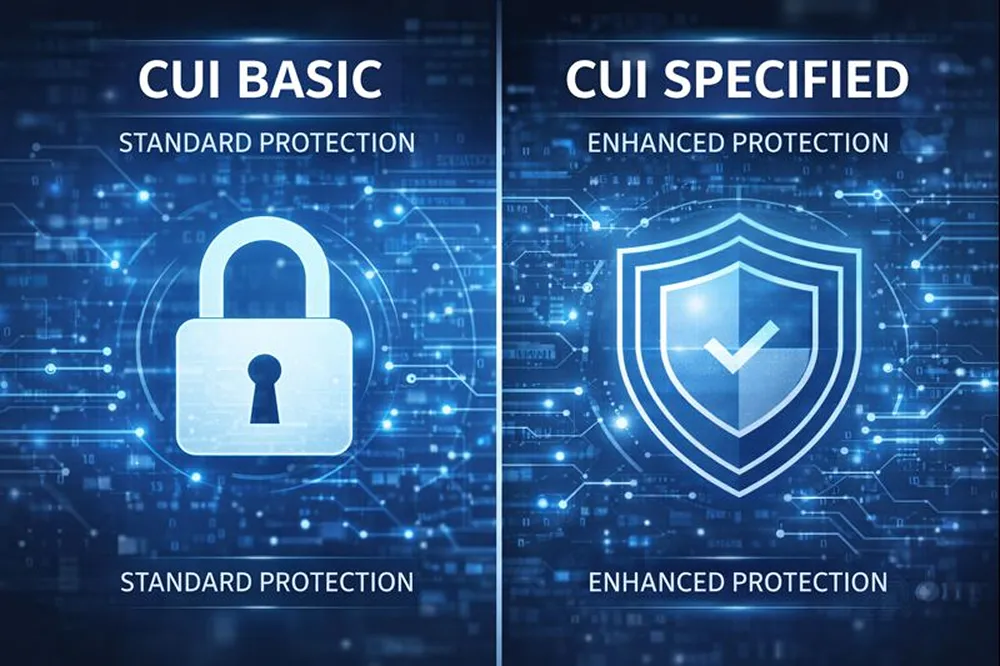
The CUI program establishes two fundamental handling levels: CUI Basic and CUI Specified. Understanding these distinctions is essential for applying appropriate safeguarding measures and ensuring compliance with cui requirements.
CUI Basic represents the baseline level of protection that agencies handle CUI Basic according to the uniform set of controls prescribed by 32 CFR Part 2002 and government-wide policies. Most controlled unclassified information falls into this category unless the authorizing law, regulation, or government-wide policy specifically requires or permits agencies to use additional handling controls beyond the baseline. CUI Basic controls apply consistently across all federal agencies and cover fundamental security practices including access restrictions, marking requirements, and transmission protocols.
CUI Specified represents a subset of CUI for which the authorizing laws, regulations, or government-wide policies set out specific handling controls that differ from those for CUI Basic. The CUI Registry indicates which laws or regulations require these enhanced controls and what specific cui specified requirements apply. For example, certain privacy information or controlled technical information related to military or space application may require encryption standards, dissemination limitations, or other measures beyond standard CUI Basic protections.
The practical difference between CUI Basic and CUI Specified affects how organizations must handle, store, and transmit the information. While CUI Basic differs from CUI Specified in the specificity of required controls, both categories mandate serious attention to safeguarding cui. Organizations must identify which type applies to their information and implement appropriate security measures. The aspects of CUI Specified handling are typically detailed either in the CUI Registry or in the specific authorizing documentation for that information category.
Marking CUI correctly ensures that everyone who encounters the information understands its sensitivity and applies appropriate handling procedures. The CUI program establishes standardized marking cui requirements that replace the inconsistent legacy markings previously used across agencies.
Basic CUI marking requirements include several elements. At a minimum, documents containing CUI must display the CUI designation prominently. The standard marking appears at the top and bottom of each page as "CUI" or "CONTROLLED." For CUI Specified information, the marking must also indicate the specific category, such as "CUI//SP-PRVCY" for privacy-related CUI Specified. Additional markings may include dissemination controls, such as "FEDCON" (limited to federal employees and contractors) or other limitations specified in the CUI Registry.
Portion markings provide granular identification of which specific sections contain cui within a larger document. This practice, similar to classified document marking, helps users identify exactly what information requires protection when excerpting or discussing document contents. Portion markings typically appear as "(CUI)" at the beginning of paragraphs, sections, or other document portions that contain sensitive information.
Electronic files and information systems containing CUI require marking as well. Email subject lines should include "CUI" when messages contain controlled unclassified information, and metadata or file properties should reflect CUI status. Physical media like USB drives, CDs, or external hard drives must be clearly labeled as CUI. Proper marking cui extends to derivative materials—if you create a new document using CUI source materials, the derivative product must be marked as cui appropriately. Organizations should implement CUI training programs ensuring all personnel understand marking requirements and can apply them consistently. Resources from the National Archives CUI program provide detailed marking guidance.
Protecting cui in information systems requires implementing technical and administrative safeguards that prevent unauthorized access, use, disclosure, or modification. The specific controls depend on whether systems are operated by federal agencies or nonfederal systems and organizations handling CUI on behalf of an agency.
For federal information systems, agencies must comply with the security requirements outlined in NIST Special Publication 800-53 and related federal information security standards. These comprehensive controls address access management, encryption, audit logging, incident response, and numerous other security domains. Federal agencies typically operate their systems within a controlled environment that includes physical security, network segmentation, and continuous monitoring capabilities.
Nonfederal organizations—primarily contractors and other entities that handle cui on behalf of the government—must meet the requirements in NIST Special Publication 800-171, "Protecting Controlled Unclassified Information in Nonfederal Systems and Organizations." This standard establishes 110 security requirements across 14 families of controls. Key requirements include access control measures ensuring only authorized users can access cui, awareness and training programs educating personnel about safeguarding cui, audit and accountability mechanisms tracking system activities, and incident response procedures for addressing security breaches.
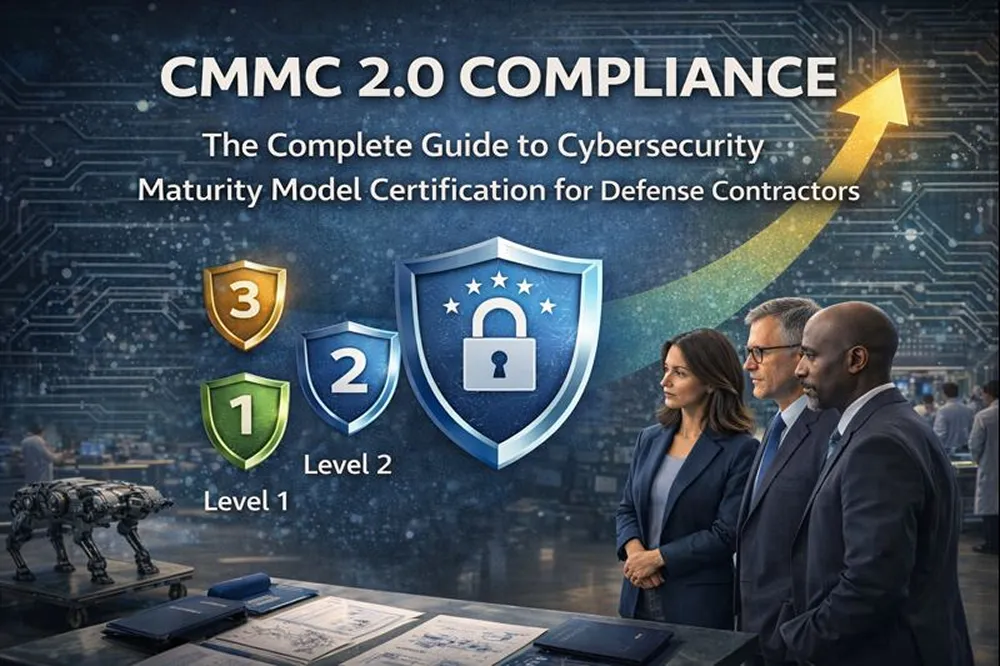
The DOD has enhanced these baseline requirements through the Cybersecurity Maturity Model Certification (CMMC) framework, which contractors must achieve to handle CUI in DOD contracts. CMMC creates maturity levels ranging from basic cybersecurity hygiene to advanced practices, with the required level depending on the sensitivity and volume of CUI involved. Organizations must undergo third-party assessment to verify CMMC compliance, raising the stakes for proper cui program implementation. Understanding these technical requirements complements knowledge of government procurement cycles for successful federal contracting.

The CUI Registry organizes controlled unclassified information into distinct categories, each with specific handling requirements derived from authorizing laws or regulations. Understanding major CUI categories helps organizations identify what information they possess and what controls apply.
Controlled Technical Information (CTI) represents a particularly significant category of CUI for defense contractors and companies involved in military or space application development. CTI includes technical information with military or space application that is subject to access and distribution controls pursuant to 10 U.S.C. 130e. This information requires robust safeguarding because unauthorized disclosure could provide adversaries with insights into U.S. military capabilities or technological advantages.
Privacy-related CUI encompasses personally identifiable information and other sensitive information about individuals that requires protection under the Privacy Act or other regulations. This category includes everything from personnel records to medical information to financial data about individuals. The cui basic controls apply to most privacy information, though some privacy data may be CUI Specified where the authorizing authority requires enhanced protections beyond baseline measures.
Export Control information represents another critical category, particularly for organizations in aerospace, defense, and advanced technology sectors. Information controlled under the International Traffic in Arms Regulations (ITAR) or Export Administration Regulations (EAR) often qualifies as CUI and requires careful handling to prevent unauthorized disclosure to foreign nationals or entities. Violations of export control requirements can result in severe penalties including criminal prosecution, making this a high-stakes category of cui. Organizations can explore tools to find government contract opportunities while ensuring they understand which CUI categories apply to their work.
Government-wide policies established through 32 CFR Part 2002 create uniform standards for how all federal agencies must manage controlled unclassified information. These regulations, issued by ISOO to establish policy for the CUI program, ensure consistency while allowing agencies flexibility to address mission-specific needs.
The regulations define fundamental concepts including what constitutes cui, how to designate information properly, and what baseline protections agencies must implement. The government-wide framework establishes that CUI must be handled using safeguarding or dissemination controls that protect against unauthorized access while enabling appropriate information sharing. This balance between security and collaboration reflects the reality that government missions often require sharing sensitive information across agencies and with contractors.
Agencies must designate a senior official as their CUI executive agent responsible for implementing the agency's cui program. This individual oversees policy development, training, self-inspection, and compliance monitoring within their organization. The CUI program structure includes mechanisms for agencies to request new CUI categories, challenge improper CUI designations, and update guidance as laws and regulations evolve.
The government-wide policies also address the full information lifecycle from creation through disposal. Requirements cover accessing cui, transmitting it securely, storing it in approved systems, and disposing of cui when it reaches the end of its retention period. These comprehensive policies create accountability and traceability, ensuring that CUI receives appropriate protection regardless of which agency creates or handles it. For organizations pursuing government work, understanding these policies is as fundamental as developing winning RFP response strategies.
Proper CUI training ensures that federal employees and contractors understand their responsibilities for identifying cui, applying appropriate controls, and reporting security incidents. Training requirements vary based on roles and the types of CUI individuals handle.
Basic CUI training should cover fundamental concepts including the purpose of the CUI program, how to identify information that may be cui using the CUI Registry, proper marking procedures, and general safeguarding requirements. All personnel who create, access, or handle cui require this foundational awareness. The training should emphasize that protecting controlled unclassified information is everyone's responsibility and that negligence or deliberate mishandling can result in serious consequences.
Role-specific training addresses the particular responsibilities of different positions. System administrators need training on technical controls for information systems containing CUI. Contracting officers and procurement professionals require training on including appropriate CUI clauses in contracts and verifying contractor compliance. Managers need to understand oversight responsibilities and how to enforce CUI policies within their organizations.
The DOD and other agencies typically require annual CUI training refreshers to reinforce concepts and update personnel on policy changes. Organizations should document all CUI training, maintaining records of who completed what training and when. This documentation demonstrates compliance during audits or investigations and helps identify gaps in organizational knowledge. Effective training programs use multiple delivery methods including online courses, instructor-led sessions, job aids, and regular reminders to keep CUI awareness top-of-mind for personnel.

The CUI Registry serves as the authoritative, government-wide source for all approved CUI categories and subcategories. Maintained by NARA and accessible online, the registry provides essential information that agencies and contractors need to properly identify and handle cui.
For each category of cui, the registry specifies the authorizing authority—the law, regulation, or government-wide policy that requires or permits agencies to control the information. This citation provides the legal foundation for CUI designation and handling requirements. The registry also indicates whether information in each category is CUI Basic or includes aspects of cui specified requiring enhanced controls beyond baseline protections.
The registry includes detailed descriptions helping users identify whether specific information falls within each category. These descriptions clarify scope and provide examples, reducing ambiguity about what information is cui. For categories that are CUI Specified, the registry details the controls for cui specified information, which may include specific marking requirements, dissemination limitations, or technical safeguarding measures.
Agencies may maintain their own CUI registries that supplement the government-wide registry with agency-specific guidance. The DOD CUI Registry, for instance, provides military-specific interpretations and examples relevant to defense operations and contracting. However, agencies cannot create new CUI categories independently—all categories must be approved through NARA and added to the authoritative government-wide registry. This centralized approach prevents the proliferation of inconsistent or unauthorized information protection schemes. Organizations can reference official NIST CUI resources for technical implementation guidance.
Failure to adequately safeguard cui can result in serious consequences for both organizations and individuals. Understanding these potential repercussions emphasizes why robust CUI programs are essential for anyone working with federal information.
For contractors, CUI violations can lead to contract termination, suspension or debarment from federal contracting, and financial penalties. When organizations fail to implement required controls or experience data breaches involving cui, agencies may invoke contract clauses allowing them to terminate for cause. The Defense Federal Acquisition Regulation Supplement (DFARS) includes specific clauses addressing CUI protection requirements, and failure to comply constitutes a material breach. Organizations that cannot demonstrate CMMC compliance will be unable to compete for DOD contracts requiring CUI handling.
Legal liability represents another significant risk. Depending on the specific cui category involved, unauthorized disclosure might violate the Privacy Act, export control laws, or other statutes carrying civil or criminal penalties. Organizations could face lawsuits from individuals whose personally identifiable information was compromised or from the government for damages resulting from CUI breaches. Cyber insurance may not cover losses if organizations failed to implement required cui safeguarding measures.
Reputational damage often proves as costly as formal penalties. Federal agencies talk to each other and review contractor performance records. Organizations known for poor CUI handling will struggle to win new contracts regardless of their technical capabilities. The trust required for government partnerships evaporates when contractors demonstrate inability or unwillingness to protect sensitive information. For individuals, cui violations can result in loss of security clearances, termination of employment, and in severe cases, criminal prosecution.
The CUI program continues evolving to address technological changes, emerging threats, and lessons learned from implementation experience. Understanding these developments helps organizations stay ahead of compliance requirements and prepare for future changes.
Cybersecurity remains a primary focus as threats to information systems grow increasingly sophisticated. The DOD's implementation of CMMC represents the most significant evolution, creating mandatory third-party assessment requirements that raise the bar for contractor security programs. Other agencies are watching CMMC implementation closely and may adopt similar approaches, making robust technical controls for protecting cui increasingly important across all federal sectors.
Cloud computing presents both opportunities and challenges for cui handling. While cloud services offer scalability and cost benefits, agencies must ensure that cloud service providers implement appropriate controls and that data sovereignty requirements are met. NARA and agencies are developing guidance on cui in cloud environments, addressing questions about where data can be stored, how to maintain control, and what assurances are needed from cloud providers.
Information sharing initiatives are pushing agencies to balance security with collaboration needs. The CUI framework intentionally avoids the over-restriction that plagued previous information protection schemes, but achieving the right balance requires continuous refinement. Agencies are developing better tools and processes for appropriate cui sharing while maintaining necessary safeguards, recognizing that information has value only when it reaches those who need it.
Understanding and implementing proper Controlled Unclassified Information handling procedures is fundamental for any organization working with federal agencies. The cui program creates accountability and standardization that protects sensitive information while enabling appropriate collaboration. Whether you're a federal employee, contractor, or organization that creates or possesses information on behalf of the government, investing in robust CUI programs, comprehensive training, and compliant information systems is essential for mission success and regulatory compliance.
Ready to ensure your organization meets CUI requirements for federal contracting? Contact our team to discuss how we can help you develop compliant programs and pursue government opportunities successfully

Are you curious about the networking events near you? Together we can expand your network and watch your pipeline exponentially grow.