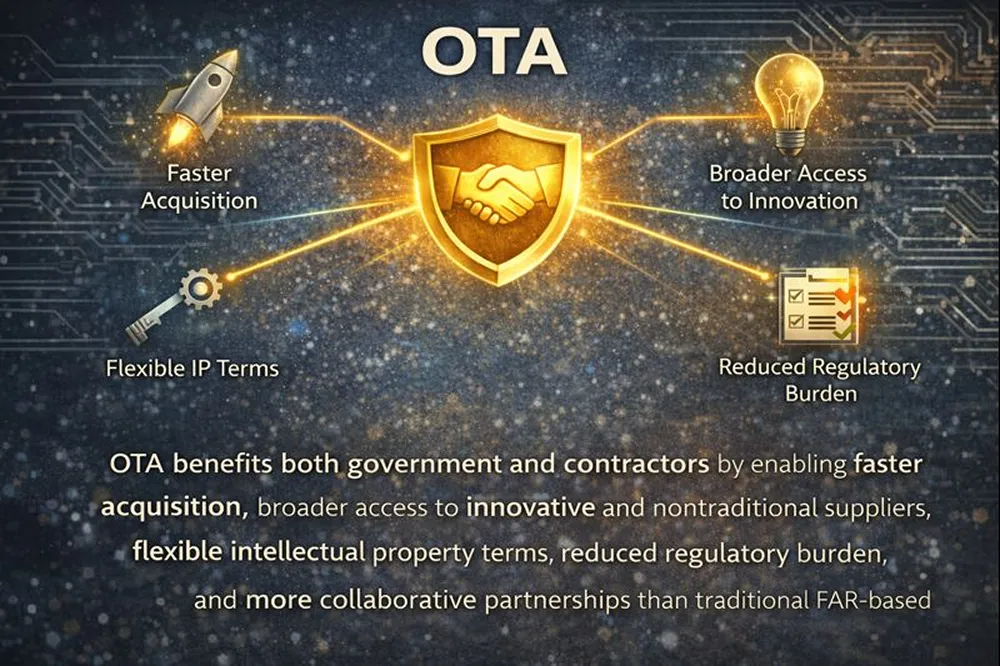
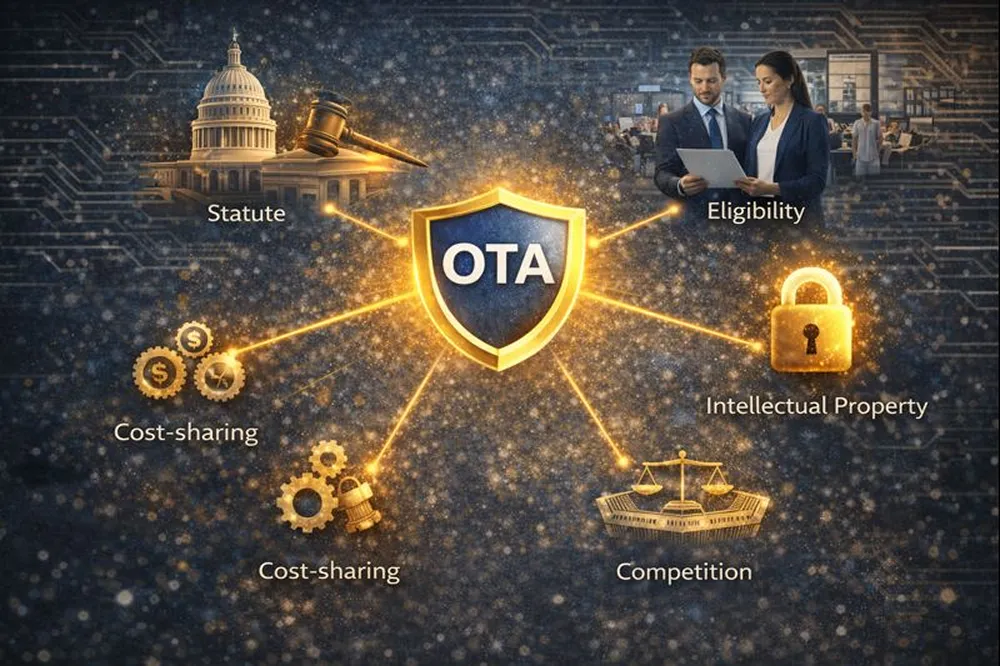
Other Transaction Authorities (OTAs) represent one of the most flexible and innovative procurement mechanisms available to federal agencies, particularly the Department of Defense. Unlike traditional government contracts bound by the Federal Acquisition Regulation, OTA agreements provide streamlined pathways for research, prototype development, and production that attract non-traditional defense contractors who might otherwise avoid government work due to regulatory complexity. This comprehensive guide explores what transaction authorities are, how OTA consortiums operate, when agencies can use an OTA, and strategic approaches for contractors seeking to participate in this rapidly growing segment of defense contracting. Whether you're a traditional defense contractor exploring alternative contract vehicles or an innovative small business considering your first government contract, understanding OTAs is essential for accessing billions in federal research and development funding while maintaining operational flexibility unavailable through FAR-based contracts.
Other Transaction Authorities represent a category of procurement instruments that federal agencies use to enter into agreements for research and development, prototype projects, and certain production activities without using traditional government acquisition processes governed by the Federal Acquisition Regulation (FAR). The term "other transaction" distinguishes these agreements from standard procurement contracts, grants, and cooperative agreements, creating a unique category with significantly greater flexibility in terms and conditions, cost-sharing requirements, intellectual property rights, and administrative requirements.
The fundamental distinction between OTAs and FAR-based contracts lies in regulatory freedom. Traditional contracts must comply with thousands of pages of federal laws and regulations covering everything from cost accounting standards to socioeconomic program requirements, labor relations, and audit procedures. OTA agreements, by contrast, incorporate only those regulations that statutes explicitly mandate, giving agencies and contractors substantial latitude to negotiate terms appropriate for specific circumstances. This flexibility proves particularly valuable for cutting-edge technology development where rigid government contracting requirements might discourage participation from innovative firms.
Congress grants transaction authorities to specific federal agencies through enabling legislation, most notably 10 U.S.C. 4021 for research projects and 10 U.S.C. 4022 for prototype projects under Department of Defense authority. Other agencies including the Department of Homeland Security, Department of Energy, and NASA also possess OTA authority under their respective statutes. However, agencies must be explicitly authorized by Congress to use other transaction authority—it's not a general procurement power available to all federal agencies. The Defense Innovation Unit has emerged as a leader in OTA utilization, streamlining access to innovative commercial technologies for defense applications.
Three primary types of OTAs exist, each serving distinct purposes within the acquisition lifecycle: research OTs under 10 U.S.C. 4021, prototype OTs under 10 U.S.C. 4022, and production OTs as follow-on agreements to successfully completed prototype projects. Understanding the distinctions, authorities, and limitations for each OTA type proves critical for both agencies and contractors navigating this procurement landscape.
Research OTs under Section 4021 support basic, applied, and advanced research projects. These agreements typically fund early-stage technology development, feasibility studies, and proof-of-concept demonstrations where outcomes remain uncertain. Research OTs carry the broadest flexibility, with minimal statutory constraints beyond basic accountability requirements. Agencies use research OTs to explore emerging technologies, engage academic institutions, and collaborate with innovative firms on long-term research initiatives. Cost-sharing requirements are discretionary, allowing fully-funded government research when appropriate or requiring participant contributions when commercial applications justify investment.
Prototype OTs under Section 4022 represent the most widely used OTA category, supporting development of prototype projects that have potential military applications. A prototype ot agreement can range from software demonstrations to hardware systems, encompassing virtually any technology relevant to defense missions. However, prototype OTs carry specific statutory requirements that research OTs don't face. Most significantly, prototype projects must include at least one nontraditional defense contractor as a significant participant in the transaction, or all significant participants must agree to cost-sharing requirements, or the prototype ot must involve innovative business arrangements or technologies not available through traditional procurement. These conditions ensure OTAs serve their intended purpose—accessing innovation beyond traditional defense industrial base sources.
Production OTAs represent follow-on agreements transitioning successful prototype projects into production and fielding. Under 10 U.S.C. 4022(f), agencies may award production OTAs without competition when specific conditions are met: the prototype project was successfully completed, the senior procurement executive determines the OTA approach is appropriate for production, and competitive procedures were used for selecting parties for the prototype transaction. Production OTAs extend flexibility into manufacturing and deployment phases, though they remain relatively rare compared to research and prototype agreements. For comprehensive background on how OTAs fit within broader federal acquisition frameworks, contractors should understand the complete OTA landscape.

OTA consortiums represent collaborative structures bringing together multiple organizations—traditional defense contractors, non-traditional defense firms, small businesses, academic institutions, and nonprofit research organizations—under a single umbrella managed by a consortium management firm. The consortium model has become the dominant approach for DOD OTA awards, with several large consortiums managing billions in transactions across diverse technology areas including autonomy, artificial intelligence, cybersecurity, advanced materials, and medical technologies.
The consortium structure provides advantages for both government sponsors and member organizations. For government customers, consortiums offer one-stop access to diverse capabilities spanning the innovation ecosystem. Rather than conducting separate solicitations to identify qualified contractors for each requirement, agencies issue OTA solicitations through established consortiums whose members have already been vetted for technical capability, business viability, and willingness to work under OTA terms. This dramatically accelerates the acquisition process, often reducing timeline from solicitation to award from 12-18 months under traditional procurement to 3-6 months through consortium OTAs.
For consortium members, participation provides access to OTA opportunities, streamlined proposal processes, and collaborative teaming environments. The consortium manager handles administrative tasks including membership management, solicitation distribution, proposal collection, and agreement execution, allowing member organizations to focus on technical solutions rather than procurement mechanics. Membership fees typically range from $1,000 to $25,000 annually depending on organization size and consortium scope, representing modest investments relative to potential contract value. Leading OTA consortiums include the National Security Innovation Network (NSIN) consortiums, ATI consortium for advanced technologies, and numerous domain-specific consortiums managed by organizations like Advanced Technology International (ATI), Parallax Advanced Research, and other consortium management firms. The Consortium for Command, Control and Communications in Cyberspace (C5) exemplifies a successful consortium model spanning multiple technology domains.
OTAs provide substantial benefits for government agencies pursuing rapid technology insertion and mission innovation. The flexibility to tailor agreement terms enables agencies to structure arrangements appropriate for specific circumstances rather than forcing all acquisitions into standardized FAR-based templates. This includes negotiating intellectual property rights that balance government needs with contractor commercial interests, establishing cost-sharing arrangements that leverage private investment, and excluding regulations that create barriers to participation without adding commensurate value.
Speed represents perhaps the most significant agency benefit. Traditional government acquisition processes typically require 18-36 months from requirement identification through contract award, with extensive documentation, approval chains, and regulatory compliance requirements creating delays. OTA processes commonly compress this timeline to 3-9 months through streamlined solicitation procedures, flexible evaluation approaches, and reduced approval requirements. For rapidly evolving technologies where windows of opportunity close quickly, this acceleration proves decisive. Additionally, OTAs enable access to non-traditional defense sources—innovative commercial firms, venture-backed startups, and technology companies that refuse traditional government work due to regulatory burden, intellectual property concerns, or culture incompatibility.
Contractors benefit from reduced regulatory burden that lowers compliance costs and preserves operational flexibility. OTAs don't require full coverage under the cost accounting standards prescribed pursuant to Section 1502 of title 41, don't mandate Truth in Negotiations Act (TINA) cost or pricing data submissions for competitive awards, and typically exclude numerous FAR clauses covering everything from preference for domestic materials to labor relations requirements. Intellectual property provisions prove particularly attractive—contractors can often retain ownership of inventions and technical data developed under OTAs, with government receiving license rights appropriate for its needs rather than automatic government-purpose rights or unlimited rights typical of procurement contracts.
Small businesses and non-traditional contractors gain access to government opportunities that might otherwise prove inaccessible due to procurement complexity or incumbent advantages in traditional contracting. The emphasis on innovation and fresh perspectives rather than past performance with government customers levels the playing field, enabling firms with superior technology to compete effectively against established defense contractors. Understanding how to navigate the government procurement cycle helps contractors identify appropriate OTA opportunities aligned with their capabilities.
While OTAs offer substantial flexibility compared to FAR-based contracts, they're not entirely regulation-free. Certain federal laws and regulations apply to all government transactions regardless of instrument type, and specific statutory requirements attach to OTAs under various circumstances. Understanding what regulations apply—and equally important, what doesn't—proves essential for both agencies and contractors operating under OTA authority.
Foundational legal requirements apply universally. All OTA agreements must comply with appropriations law governing use of federal funds, anti-deficiency act restrictions preventing government obligations exceeding available funding, and various criminal statutes prohibiting fraud, bribery, and other illegal conduct. Civil rights laws, environmental regulations, and safety requirements generally apply when relevant. Additionally, OTAs for prototype projects must satisfy one of three conditions established in 10 U.S.C. 4022: include at least one significant nontraditional defense contractor participant, require all significant participants in the transaction to share costs, or involve exceptional circumstances justifying OTA use.
Regulations implementing section 4022 establish additional requirements for prototype OTAs. Competition must be promoted to maximum extent practicable, though specific competitive procedures aren't mandated as they are for procurement contracts. Documentation requirements exist, though less extensive than FAR-based acquisitions. Agreements must include appropriate safeguards for government interests including audit rights, intellectual property provisions, and termination clauses. Production OTAs face heightened requirements including senior procurement executive approval and determination that competitive procedures were used for the underlying prototype transaction.
Certain regulations that contractors might expect don't apply to OTAs unless specifically incorporated by agreement. The Cost Accounting Standards don't automatically apply—prototype ot agreements involving significant cost sharing by parties other than the federal government are exempt from full coverage under the cost accounting standards, and even other OTAs aren't automatically subject to CAS. The Truth in Negotiations Act doesn't require certified cost and pricing data for competitive OTA awards. Many socioeconomic programs including Buy American Act, Service Contract Act, and Davis-Bacon Act don't apply unless the agency elects to include them. This regulatory relief represents core OTA value—eliminating requirements that don't serve compelling government interests in innovation contexts. The Defense Acquisition University provides comprehensive training on OTA requirements and best practices.

Joining an OTA consortium represents the primary pathway for most contractors seeking to participate in consortium-based OTA opportunities. The process typically involves identifying relevant consortiums aligned with your technical capabilities and business interests, submitting membership applications, paying membership fees, and maintaining active participation to maximize opportunity visibility.
Research and selection prove critical first steps. Dozens of OTA consortiums exist, each focused on specific technology domains, government agencies, or mission areas. Contractors should evaluate consortiums based on several factors: technology alignment with your capabilities, contract volume and award history, membership composition and teaming opportunities, membership fees and participation requirements, and consortium manager reputation and effectiveness. Reviewing publicly available information including consortium websites, past OTA solicitations, and award data in USASpending.gov helps assess which consortiums offer the best strategic fit. Some contractors join multiple consortiums to maximize opportunity access, while others concentrate on one or two most aligned with core capabilities.
The membership application process varies by consortium but generally requires demonstrating technical capabilities through capability statements, financial viability through business documentation, and willingness to accept OTA terms and conditions. Some consortiums maintain selective membership standards, while others accept any qualified organizations willing to pay fees. Once accepted, maintaining active engagement proves essential—responding to member surveys, attending consortium events, monitoring solicitation announcements, and building relationships with both the consortium manager and potential teaming partners.
Positioning for specific OTA awards requires proactive business development. When consortium managers release OTA solicitations, timelines often run just 30-60 days from announcement to proposal submission—insufficient for building teams, developing technical approaches, and preparing competitive proposals from scratch. Successful contractors conduct continuous market research on emerging government requirements, pre-position relationships with complementary firms for teaming, maintain current technical and past performance information, and develop solution concepts in anticipation of solicitations. Additionally, direct engagement with government program managers, attendance at industry days, and participation in white paper or pitch events often precede formal solicitations, providing opportunities to shape requirements and demonstrate capabilities. Contractors should master winning strategies for proposals that translate effectively to OTA solicitation responses.
Non-traditional defense contractors represent a cornerstone of OTA policy, with statutory provisions explicitly designed to encourage participation from organizations that haven't traditionally worked with the Department of Defense. The definition carries legal significance: a non-traditional defense contractor means an entity that has not performed, as either a prime contractor or a subcontract for the department, any contract or subcontract for the Department of Defense that is subject to full coverage under the cost accounting standards during the one-year period preceding the solicitation.
This definition intentionally excludes established defense contractors who regularly work under FAR-based procurement contracts, reserving non-traditional status for organizations bringing fresh perspectives and innovative approaches to defense challenges. Commercial technology companies, venture-backed startups, small businesses without prior government experience, academic research institutions, and foreign entities can all qualify as non-traditional defense contractors provided they meet the "no full CAS coverage" criterion during the relevant period.
The significance of non-traditional participation manifests in statutory requirements for prototype OTs. One of the three conditions that must be satisfied to use prototype OT authority requires at least one nontraditional defense contractor to be a significant participant in the transaction. This requirement ensures OTAs fulfill their congressional intent—accessing innovation beyond the traditional defense industrial base. "Significant participation" isn't precisely defined by statute but generally means meaningful technical contributions and substantial financial involvement rather than token subcontracting arrangements.
For traditional defense contractors, partnering with non-traditional firms provides pathways to OTA participation. Many successful OTA awards feature teaming arrangements pairing traditional contractors' government experience, systems integration capabilities, and production capacity with non-traditional partners' innovative technologies, agile development approaches, and commercial best practices. These partnerships leverage complementary strengths while satisfying statutory requirements. Small businesses and startups particularly benefit from non-traditional status, as it creates explicit statutory preferences encouraging their participation in defense innovation activities. Understanding various contract types and opportunities helps non-traditional contractors identify appropriate entry points.
Intellectual property rights represent one of the most significant differences between OTAs and traditional procurement contracts, offering flexibility that proves essential for attracting non-traditional defense contractors and commercial firms reluctant to surrender IP developed with substantial private investment. Unlike FAR-based contracts where government automatically receives extensive data rights, OTA agreements enable negotiated IP provisions balancing government needs with contractor commercial interests.
Under traditional government contracts, the government typically receives unlimited rights to technical data and software developed exclusively with government funding, government-purpose rights for data developed with mixed funding, and limited rights for data developed exclusively at private expense. These rights enable government competition for follow-on work, organic support, and technology transfer but can discourage contractors from using their best existing technologies or making substantial private investments when data rights implications prove unfavorable.
OTA agreements approach IP differently, treating intellectual property provisions as negotiable terms rather than predetermined outcomes. Government agencies articulate their actual needs—typically focused on ensuring the government can use, maintain, and sustain acquired capabilities—while contractors retain ownership of background intellectual property and often inventions created during performance. License rights rather than data rights often govern government access, with scope and exclusivity negotiated based on factors including relative funding contributions, commercial applicability, and national security considerations.
Cost-sharing significantly impacts IP outcomes in OTA negotiations. When contractors contribute substantial private funding—particularly the cost-sharing requirements that can substitute for non-traditional contractor participation under 10 U.S.C. 4022—they retain stronger IP positions than when government provides full funding. This trade-off incentivizes private investment while ensuring government receives appropriate rights given its financial contribution. The negotiated nature of OTA IP provisions requires sophisticated understanding on both sides, with contractors needing clear IP strategies and government negotiators balancing mission needs against attracting top-tier technology partners. The National Institute of Standards and Technology (NIST) provides guidance on IP considerations in government-industry technology partnerships.
Transitioning successful prototype projects from development through production to operational deployment represents a critical challenge in defense acquisition. OTAs offer streamlined pathways for this transition through follow-on production authorities, though requirements exist to ensure appropriate competition and oversight before committing to production-scale investments.
The statutory framework for production OTAs appears in 10 U.S.C. 4022(f), which authorizes follow-on production contracts or transactions without competition when specific conditions are met. First, the OTA must be a follow-on to a prototype ot agreement that has been successfully completed. "Successfully completed" means the prototype demonstrated technical feasibility and met performance objectives established in the agreement, though it doesn't require operational testing or formal acquisition milestone decisions. Second, the senior procurement executive must determine the OTA approach is appropriate for production based on factors including schedule, cost, and mission requirements.
Third, competitive procedures must have been used for selecting parties for the prototype transaction. This requirement ensures the production award stems from a competitively selected prototype rather than circumventing competition through a research-to-production pipeline. The competition requirement focuses on the initial prototype selection, not production itself—the value proposition lies in avoiding re-competition when prototype performers have demonstrated capability, enabling faster transition while preserving initial competitive selection benefits.
Production OTAs remain relatively uncommon compared to research and prototype agreements, partly due to agencies' comfort with traditional procurement contracts for production activities and partly due to the significant oversight and approval requirements for production OTAs. Many prototype projects transition to traditional FAR-based production contracts rather than follow-on production OTAs, particularly when prototype performers qualify as traditional contractors comfortable operating under FAR. However, when prototype developers are non-traditional firms that would struggle with FAR compliance or when rapid production deployment proves essential, production OTAs provide valuable flexibility. Agencies considering production OTAs must carefully document prototype success, competitive procedures used, and senior procurement executive determinations to satisfy statutory requirements and withstand potential oversight scrutiny.
Despite growing OTA utilization, misconceptions persist among government contracting officers, contractors, and oversight officials that can impede effective OTA implementation or create unrealistic expectations. Understanding what OTAs actually are—and equally important, what they're not—helps stakeholders leverage these authorities appropriately.
A common misconception portrays OTAs as "regulation-free zones" where anything goes. While OTAs offer substantial flexibility compared to FAR-based contracts, they're not exempt from all federal laws and regulations. Appropriations law, anti-deficiency requirements, civil rights statutes, and various other legal requirements apply regardless of transaction instrument. Agencies retain responsibility for appropriate stewardship of taxpayer funds, and contractors remain accountable for performance, financial management, and ethical conduct. The flexibility lies in absence of FAR's comprehensive regulatory framework, not in absence of any rules whatsoever.
Another misconception suggests OTAs are only for small businesses or non-traditional contractors. While statutes encourage non-traditional participation, traditional defense contractors regularly participate in OTAs—often as prime contractors leading teams that include non-traditional partners, or as team members bringing complementary capabilities. Large defense contractors have successfully leveraged OTA authority for major programs, demonstrating that OTAs serve innovation and speed goals rather than simply size-based preferences.
Some believe OTAs completely replace competitive procedures with sole-source arrangements. In reality, competition remains a fundamental principle for OTAs. Statutes require agencies to promote competition to the maximum extent practicable, and most OTAs result from competitive solicitation processes. While mechanisms differ from FAR-based competition—with greater flexibility in evaluation approaches and source selection procedures—competitive selection remains the norm rather than exception.
Finally, misconceptions exist about cost and pricing. Some contractors believe OTAs eliminate government scrutiny of proposed costs, while some government officials assume OTAs expose agencies to unconstrained pricing risks. The reality falls between these extremes: OTAs don't require certified cost and pricing data under TINA for competitive awards, but agencies still evaluate cost reasonableness and negotiate fair and reasonable pricing. Cost-type OTAs include appropriate cost controls, while fixed-price OTAs protect government from cost growth risks. The difference lies in reduced documentation requirements and greater flexibility in pricing approaches, not in absence of fiscal responsibility.

OTA utilization has expanded dramatically over the past decade, growing from approximately $1 billion annually in 2015 to over $15 billion by 2024, representing roughly 10% of total DOD contract obligations. This growth reflects both congressional encouragement through expanded authorities and agency recognition of OTA value for accessing innovation and accelerating acquisition. Understanding emerging trends helps contractors and agencies prepare for evolving OTA landscape.
Consortium proliferation continues, with new OTA consortiums regularly emerging across diverse technology domains. While early consortiums focused primarily on information technology and emerging technologies, newer consortiums address medical technologies, logistics innovation, training and simulation, space systems, and virtually every defense mission area. This proliferation creates opportunities for specialized contractors while potentially fragmenting the OTA ecosystem and creating membership cost burdens for contractors attempting to maintain broad market access across multiple consortiums.
Software and digital technology increasingly dominate OTA awards, reflecting both defense modernization priorities and commercial firms' preferences for OTA flexibility over traditional procurement. Artificial intelligence, cybersecurity, autonomous systems, and data analytics account for substantial OTA investment, with traditional hardware-centric defense programs slower to adopt OTA approaches. This pattern suggests OTAs may evolve into the default acquisition strategy for digital technologies while remaining alternatives to traditional procurement for physical systems.
Oversight and accountability mechanisms continue maturing as OTA volumes increase. Congressional interest in OTA utilization, Government Accountability Office scrutiny of OTA practices, and Department of Defense efforts to establish consistent OTA policies indicate movement toward greater standardization and oversight. This evolution balances preserving OTA flexibility against ensuring appropriate stewardship and accountability as OTAs grow from niche alternatives to mainstream acquisition approaches. Contractors and agencies should anticipate enhanced documentation requirements, more rigorous competition procedures, and increased post-award auditing even as core OTA flexibility persists. The Government Accountability Office regularly publishes reports analyzing OTA trends and recommending policy improvements.
Can any federal agency use OTA authority? No, agencies must be explicitly authorized by Congress through specific statutory provisions. The Department of Defense has the broadest OTA authority under 10 U.S.C. 4021 and 4022. Other agencies including DHS, DOE, NASA, and several others possess OTA authority under their respective statutes, but it's not a universal procurement power available to all federal agencies without explicit authorization.
Do OTAs require following Federal Acquisition Regulation procedures? Generally no, though some FAR principles may apply voluntarily. OTAs represent "other than" procurement, grants, and cooperative agreements, placing them outside FAR's mandatory coverage. However, specific regulations implementing statutes like 10 U.S.C. 4022 establish requirements that must be followed, and agencies often adapt certain FAR practices as best practices even when not legally required.
How do audit rights work under OTA agreements? Audit provisions are negotiated terms rather than automatic requirements. Government agencies typically include audit rights enabling access to contractor records for verifying costs and compliance, but the specific scope, timing, and procedures are negotiated based on agreement type, cost-sharing arrangements, and risk considerations. This differs from FAR contracts where audit rights are predetermined.
Can foreign companies participate in OTA consortiums and agreements? Yes, foreign entities can participate as non-traditional defense contractors if they meet the definition of not having recent full CAS coverage for DOD work. However, technology transfer restrictions, security requirements, and policy considerations may limit foreign participation in specific OTA projects involving sensitive technologies or classified information. Each consortium and agency establishes their own policies regarding foreign participation.
What happens if a prototype project fails—does the contractor face penalties? OTA agreements are typically structured to accommodate technical risk inherent in advanced research and prototype development. Failure to achieve all technical objectives doesn't automatically constitute breach or trigger penalties, provided the contractor made good faith efforts and complied with agreement terms. This risk-tolerant approach distinguishes OTAs from traditional contracts with firm performance requirements.
Other Transaction Authorities represent transformative tools for modernizing defense acquisition, breaking down barriers that historically separated innovative commercial firms from government customers while providing traditional defense contractors with flexible alternatives to procurement or transaction rigidity. Success in the OTA ecosystem requires understanding what authorities exist, how consortiums operate, what requirements apply despite flexibility, and how to position capabilities for competitive advantage. Contractors who master OTA navigation—whether through consortium membership, teaming with non-traditional partners, or developing innovative solutions aligned with emerging requirements—position themselves to capture significant opportunities in this rapidly growing acquisition segment. As OTAs continue evolving from alternative approaches to mainstream acquisition strategies for innovation-focused programs, early movers who develop OTA expertise and relationships gain sustainable advantages in an increasingly competitive landscape where speed, innovation, and flexibility determine success.

Are you curious about the networking events near you? Together we can expand your network and watch your pipeline exponentially grow.