The Federal Acquisition Regulation (FAR) Part 13 governs simplified acquisition procedures, establishing the framework for how federal agencies acquire supplies and services below certain dollar thresholds with reduced administrative burden. Recent developments including a significant class deviation for FAR Part 13 have transformed how contracting officers conduct simplified acquisitions, particularly for commercial products and commercial services. This deviation for FAR Part 13 represents the most substantial FAR overhaul in this area in years, introducing new simplified procedures for certain commercial products, expanding the use of fast payment procedures, and streamlining acquisition methods to promote competition to the maximum extent practicable while reducing administrative costs. Understanding these changes is critical for contractors seeking to capitalize on simplified acquisition opportunities, as the updated procedures affect everything from threshold amounts to contract terms and conditions. Whether you're pursuing commercial purchases under FAR Subpart 13.5, navigating micro-purchase threshold requirements, or responding to solicitations for supplies or services in amounts greater than the simplified acquisition threshold but not exceeding $7.5 million, mastering the current state of Part 13 is essential for success in federal procurement.
FAR Part 13 establishes the policies and procedures governing simplified acquisitions—purchases of supplies or services where the anticipated dollar value does not exceed the simplified acquisition threshold. This part of the Federal Acquisition Regulation authorizes the use of simplified acquisition procedures to reduce administrative costs and improve efficiency when acquiring commercial products or commercial services and other supplies or services at lower dollar values.
The fundamental purpose of Part 13 is to simplify the acquisition process for purchases that don't warrant the extensive documentation, evaluation, and oversight required for major procurements. The regulation recognizes that applying full and open competition procedures to every government purchase—regardless of value—would be inefficient and wasteful. By establishing streamlined procedures for acquisitions below certain thresholds, FAR Part 13 enables agencies to acquire supplies and services more quickly while still maintaining appropriate competition, fairness, and accountability.
For contractors, FAR Part 13 represents a critical segment of federal procurement opportunity. Simplified acquisitions account for a substantial volume of government purchasing activity, creating accessible entry points particularly for small businesses. The streamlined nature of Part 13 procedures means lower barriers to entry, faster award cycles, and less complex proposal requirements compared to major procurements. Understanding how contracting officers may use these procedures, what requirements apply, and how to position your company for success in simplified acquisitions is essential for any contractor pursuing federal opportunities. Resources like understanding the government procurement cycle provide broader context for where Part 13 fits within overall federal acquisition strategy.
FAR Part 13 establishes multiple dollar thresholds that determine which simplified procedures apply and what requirements contracting officers must follow. Understanding these thresholds is fundamental to navigating simplified acquisitions effectively.
The micro-purchase threshold currently stands at $10,000 for most purchases (with higher amounts for specific situations including certain construction and services). Acquisitions at or below this threshold may be conducted with minimal competition requirements and documentation. Contracting officers may use purchase cards for micro-purchases, and the submission of a quotation does not establish a binding contract—rather, the issuance by the government of an order or the acceptance of an offer creates the contractual relationship. These ultra-simplified procedures enable rapid acquisition of routine supplies or services needed for day-to-day operations.
The simplified acquisition threshold represents the upper limit for using standard simplified acquisition procedures, currently set at $250,000 for most acquisitions. Between the micro-purchase threshold and this simplified acquisition threshold, more structured procedures apply including requirements to promote competition, document price reasonableness, and follow specific evaluation and award procedures. However, these procedures remain substantially less burdensome than full and open competition required for acquisitions that exceed the simplified acquisition threshold.
For certain commercial products and commercial services, FAR Subpart 13.5 establishes special simplified procedures for amounts greater than the simplified acquisition threshold but not exceeding $7.5 million. These "test program" procedures combine elements of Part 12 commercial item acquisition with Part 13 simplified procedures, extending streamlined approaches to higher dollar values when acquiring commercial products or commercial services. This expanded threshold reflects policy priorities encouraging commercial item acquisition and recognizing that commercial marketplace practices provide appropriate discipline. Understanding which threshold applies to specific opportunities helps contractors assess competition levels, proposal requirements, and overall pursuit strategy. The Acquisition.gov website provides official guidance on current thresholds and regulatory updates.

A class deviation for FAR Part 13 represents a temporary authorization allowing federal agencies to deviate from specific FAR requirements in a systematic way across multiple contracts. Recent class deviations have introduced significant changes to how contracting officers conduct simplified acquisitions, particularly regarding commercial purchases and fast payment procedures.
Class deviations typically arise when agencies identify operational needs or efficiencies that existing FAR provisions don't adequately address, yet changing the FAR itself would require lengthy regulatory processes. The senior procurement executive at an agency or the Office of Federal Procurement Policy may authorize class deviations when they determine such deviations are necessary and appropriate. These deviations remain in effect for specified periods and often serve as testing grounds for potential permanent FAR changes.
Recent class deviation activity affecting Part 13 has focused on expanding flexibilities for commercial product and commercial service acquisition, streamlining fast payment procedures, and reducing administrative burden for contracting officers conducting simplified acquisitions. These deviations reflect ongoing efforts toward a comprehensive FAR overhaul that modernizes acquisition procedures to match contemporary commercial practices while maintaining appropriate oversight and competition. For contractors, understanding current class deviations is essential because they directly affect how agencies structure solicitations, evaluate quotations, and award contracts. Deviations may change competition requirements, alter terms and conditions, or modify documentation expectations—all factors that impact contractor response strategies.
FAR Subpart 13.5 establishes simplified procedures for certain commercial products and commercial services in amounts greater than the simplified acquisition threshold but not exceeding $7.5 million for acquisitions as prescribed in that subpart. These special procedures represent a hybrid approach combining commercial item acquisition principles with simplified acquisition efficiency.
The procedures for the acquisition of commercial products or commercial services under Subpart 13.5 allow contracting officers to use streamlined solicitation, evaluation, and award methods even for relatively high-value purchases. When using these procedures, the policies applicable to the acquisition of commercial products and commercial services in FAR Part 12 apply subject to the order of precedence provided in Subpart 13.5. This means commercial item terms and conditions govern, but within the streamlined framework that simplified procedures provide.
Contracting officers may use these procedures when they determine that the anticipated dollar value of the acquisition will exceed the simplified acquisition threshold but not exceed $7.5 million (including options), and the acquisition is for commercial products or commercial services. Market research must support the determination that the supplies or services being acquired are commercial items. The streamlined approach includes simplified synopsis requirements, flexible solicitation methods, streamlined evaluation procedures, and reduced documentation compared to standard procurement above the simplified acquisition threshold.
For contractors, offerings qualifying as commercial products or commercial services create access to these extended simplified procedures up to $7.5 million—significantly higher than the standard $250,000 simplified acquisition threshold. Understanding FAR Part 12 commercial item definitions and maintaining commercial sales practices that support commercial item determinations maximizes access to these opportunities. Contractors should emphasize commercial item status in capability statements and marketing materials, as this classification unlocks streamlined acquisition approaches that benefit both agencies and suppliers. Understanding winning strategies for government RFP responses helps even when responding to these streamlined commercial item opportunities.
Fast payment procedures represent a streamlined payment mechanism that contracting officers may use for certain simplified acquisitions, reducing administrative burden for both government and contractors. Understanding when and how fast payment applies helps contractors optimize cash flow and administrative efficiency.
The fast payment procedure allows payment to contractors based on the contractor's submission of an invoice rather than requiring government verification of receipt and acceptance. Under fast payment, the government essentially pays upon the contractor's certification that supplies or services have been delivered, without independent verification by the receiving office. This approach accelerates payment cycles dramatically compared to standard payment procedures requiring government inspection and acceptance before payment processing.
Contracting officers may authorize fast payment when certain conditions are met, including that the acquisition is for supplies or services where aggregate payment will not exceed the simplified acquisition threshold, and payment is advantageous to the government. Fast payment particularly suits acquisitions of commercial products or services from established suppliers where the risk of non-performance is minimal and administrative costs of verification would be disproportionate to the contract value. The procedure includes safeguards protecting government interests, such as contractor certification requirements and government audit rights.
For contractors, fast payment procedures offer significant cash flow advantages by accelerating payment cycles from weeks to days. When contracting officers indicate that fast payment will apply to a contract, contractors should ensure they understand certification requirements, maintain accurate delivery records, and submit proper invoices promptly upon delivery. However, contractors should also recognize that fast payment carries responsibilities—improper certifications or delivery failures can result in payment recoupment and potential suspension or debarment. The administrative simplicity of fast payment benefits both parties when used appropriately for low-risk commercial purchases where verification costs would exceed the value gained.

Competition remains a fundamental requirement throughout Part 13, though implemented with flexibility reflecting the streamlined nature of simplified acquisitions. Understanding how contracting officers must promote competition helps contractors identify opportunities and agencies ensure compliance.
For acquisitions with a dollar value above the micro-purchase threshold, the contracting officer shall promote competition to the maximum extent practicable. This requirement typically means soliciting quotations from at least three sources when feasible, though specific circumstances may justify more limited competition. The "maximum extent practicable" standard provides flexibility that strict full and open competition requirements lack—contracting officers may tailor competition strategies based on market conditions, urgency, administrative efficiency, and the dollar value of the acquisition.
Market research plays a critical role in satisfying competition requirements under Part 13. Before conducting a simplified acquisition, contracting officers shall conduct market research to identify potential sources and determine whether commercial products or commercial services are available to meet the requirement. This research informs decisions about how broadly to compete acquisitions and whether small business set-asides are appropriate. For contractors, visibility through market research channels—including registration in SAM, holding relevant GSA Federal Supply Schedule contracts, and participation in industry events—increases the likelihood contracting officers will identify and solicit your company.
Even when using simplified procedures, contracting officers must consider price and other factors to determine which quotation provides the best value. While evaluation procedures are streamlined compared to formal source selection, agencies still must make reasoned decisions about which contractor offers the best combination of price, technical capability, and past performance. Documentation requirements are reduced but not eliminated—contracting officers must maintain contract files supporting their competition and award decisions. Understanding these competition principles helps contractors position themselves effectively and agencies maintain compliance while leveraging the efficiency benefits that simplified procedures provide. Resources like tools to find government contract opportunities help contractors identify competitive simplified acquisitions.
FAR Part 13 includes specific provisions designed to improve opportunities for small businesses, recognizing the important role that simplified acquisitions play in enabling small business participation in federal contracting. Understanding these provisions helps small businesses access protected opportunities while agencies meet small business contracting goals.
For acquisitions of supplies or services that have an anticipated dollar value above the micro-purchase threshold but not exceeding the simplified acquisition threshold, the acquisition shall be set aside for small businesses unless the contracting officer determines there is not a reasonable expectation of obtaining offers from two or more small business concerns that are competitive in price, quality, and delivery. This presumption favoring small business set-asides creates protected competition where small businesses don't face large business competitors, significantly improving win rates and providing accessible opportunities for building past performance.
Specific socioeconomic small business categories receive additional preferences within the Part 13 framework. Contracting officers must consider whether to set aside acquisitions for service-disabled veteran-owned small businesses, HUBZone small businesses, women-owned small businesses, or economically disadvantaged women-owned small businesses. These targeted set-asides further limit competition, creating even more favorable conditions for certified small businesses in these categories. The order of precedence for applying these set-asides follows specific rules, with certain categories taking priority when multiple set-aside options exist.
Even beyond formal set-asides, small business considerations influence simplified acquisition decisions. Agencies must meet government-wide and agency-specific small business contracting goals, creating institutional incentives to award work to small concerns. Contracting officers may consider whether offerors are small businesses when making award decisions even in unrestricted competitions. For small businesses, maintaining current small business certifications, emphasizing small business status in marketing materials, and building relationships with agencies' small business specialists maximizes access to these protected opportunities. Resources from the Small Business Administration provide detailed guidance on certification requirements and set-aside programs.
The government purchase card represents one of the most common simplified acquisition methods, enabling rapid procurement of supplies or services with minimal administrative burden. Understanding purchase card procedures helps contractors access this significant market segment while agencies leverage the efficiency benefits these instruments provide.
Purchase cards function like commercial credit cards, allowing authorized cardholders to make purchases up to their designated dollar limits without traditional procurement documentation. For purchases at or below the micro-purchase threshold, cardholders may acquire supplies or services directly from suppliers, with the card transaction constituting the government's acceptance and creating a binding contract. This streamlined approach eliminates purchase orders, formal solicitations, and contract documents for routine low-value purchases, dramatically reducing administrative costs.
The contracting officer may authorize use of purchase cards for acquisitions above the micro-purchase threshold when advantageous to the government, subject to certain limitations and oversight requirements. As dollar values increase, additional controls apply including requirements for multiple quotes, supervisory approvals, and enhanced documentation. However, even with these controls, purchase card acquisitions remain substantially more streamlined than traditional contract processes. The flexibility and speed of purchase cards make them ideal for routine supplies, emergency purchases, and other situations where traditional procurement would be inefficient.
For contractors, accepting government purchase cards expands market access by making it easy for agencies to procure from you without complex contracting procedures. Contractors should ensure their payment processing systems can handle government cards, understand that purchase card transactions are binding contracts subject to the same fundamental requirements as formal contracts, and maintain proper documentation supporting all purchase card sales. Building relationships with cardholders at agencies whose missions align with your products or services can generate steady revenue streams from recurring purchases. While individual transactions may be small, cumulative purchase card business from regular customers can become substantial.

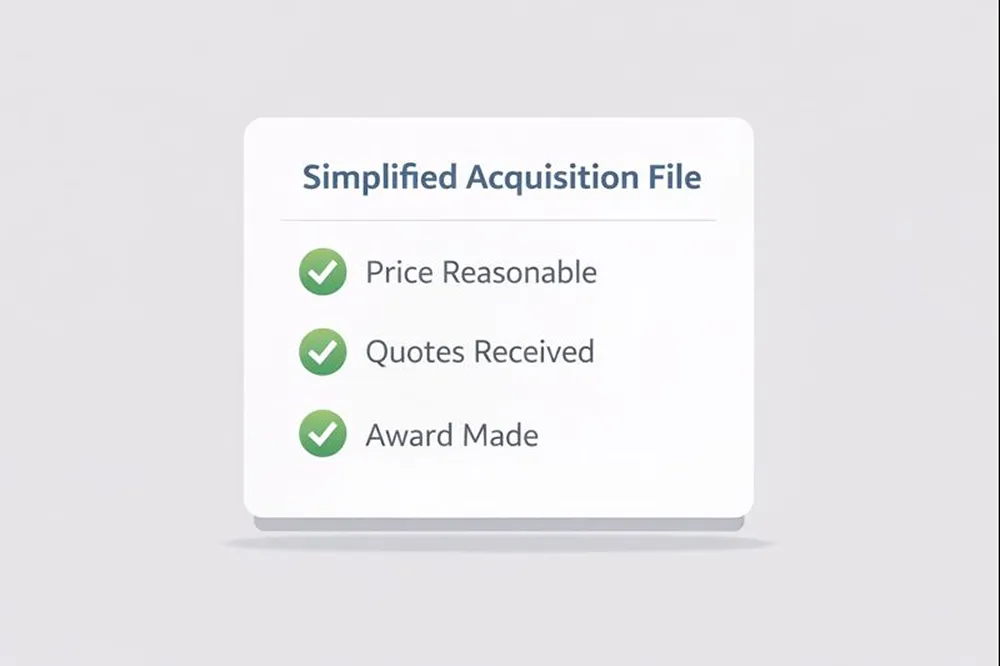
Despite the streamlined nature of simplified acquisitions, contracting officers must maintain contract files documenting acquisition decisions, competition conducted, price reasonableness determinations, and contract administration activities. Understanding these requirements helps contractors appreciate what information agencies need and why certain documentation may be requested.
The contract file for simplified acquisitions must include sufficient documentation to support the acquisition decision and demonstrate compliance with applicable requirements. However, Part 13 explicitly reduces documentation requirements compared to formal procurements. For acquisitions below the simplified acquisition threshold, the contracting officer shall follow streamlined documentation procedures including simplified acquisition planning documentation, streamlined synopsis requirements (if public notice is required), and simplified file organization.
Price reasonableness documentation represents a critical file element for simplified acquisitions. The contracting officer must determine that the price for the quantity to be procured is fair and reasonable, documenting the basis for this determination. For commercial products or commercial services, comparison to recent purchases of similar items often satisfies this requirement. For other purchases, the contracting officer may rely on market research, price comparisons from multiple quotations, or analysis of price components. Contractors can facilitate price reasonableness determinations by providing clear pricing breakdowns, explaining the basis for costs, and highlighting commercial sales at comparable prices when applicable.
Other required documentation includes determination that the acquisition is set aside for small businesses (when applicable), synopsis documentation (for purchases exceeding certain thresholds), and records of the competition conducted. The contract file shall also include all contractual documents including the solicitation (if formal), quotations received, award documentation, and contract modifications. While Part 13 reduces the volume of documentation required, it doesn't eliminate accountability—agencies must still demonstrate they made informed decisions using appropriate procedures and competitive practices. Understanding government proposal writing helps contractors provide information supporting these documentation needs.
Task or delivery order contracts represent important vehicles for simplified acquisitions, enabling agencies to establish contract frameworks and then issue individual orders for specific requirements as they arise. Understanding how these vehicles interact with Part 13 procedures helps contractors access recurring opportunities through streamlined ordering processes.
Contracting officers may establish indefinite-delivery indefinite-quantity (IDIQ) contracts using Part 13 procedures when the anticipated aggregate amount of orders will not exceed the simplified acquisition threshold. These umbrella contracts establish basic terms and conditions, pricing structures, and ordering procedures, with specific requirements addressed through individual task or delivery orders issued against the basic contract. This approach combines the efficiency of simplified acquisitions with the convenience of pre-established contract vehicles, benefiting both agencies and contractors.
When issuing orders against existing contracts including GSA Federal Supply Schedule contracts, simplified ordering procedures apply depending on the dollar value of the specific order. For orders below certain thresholds, agencies may place orders directly without additional competition or evaluation. For higher-value orders, even when using existing contract vehicles, additional competition among contract holders may be required to ensure best value. Understanding these ordering procedures helps contractors holding relevant contract vehicles respond appropriately when agencies issue Requests for Quotes (RFQs) against those vehicles.
The interaction between Part 13 simplified procedures and ordering procedures under other FAR parts creates complexity that both agencies and contractors must navigate. The specific procedures depend on the dollar value of the order, the type of contract vehicle, and whether the order is for commercial products or commercial services. Contractors should understand which contract vehicles they hold and what ordering procedures apply to each, enabling them to respond quickly when agencies issue orders using those vehicles. Maintaining current pricing and availability information on all contract vehicles ensures agencies can place orders efficiently when requirements arise.

Ongoing discussions about comprehensive FAR reform include significant attention to Part 13 and how simplified acquisition procedures could be further modernized to match contemporary commercial practices while maintaining appropriate oversight. Understanding potential changes helps contractors and agencies prepare for future requirements.
Proposed FAR overhaul initiatives often focus on raising thresholds to reflect inflation and maintain the policy effectiveness of simplified procedures. As the cost of goods and services increases over time, static thresholds gradually capture more routine purchases within complex procurement procedures—exactly the opposite of what simplified acquisition policies intend. Future threshold increases would expand the universe of acquisitions eligible for streamlined procedures, creating more opportunities for contractors and greater efficiency for agencies. Monitoring regulatory developments through the Federal Register and acquisition-focused publications helps stakeholders stay informed about proposed changes.
Digital transformation initiatives may bring significant changes to how simplified acquisitions are conducted. Enhanced electronic marketplaces, artificial intelligence for price reasonableness analysis, automated market research tools, and streamlined electronic quotation platforms could further reduce administrative burden while improving competition and transparency. These technological advances align with the fundamental objectives of Part 13—reducing costs and accelerating acquisition—while leveraging capabilities that didn't exist when current procedures were developed. Contractors should prepare for increasingly digital procurement processes requiring electronic participation and rapid online responses.
Policy emphasis on expanding commercial item acquisition and reducing barriers for non-traditional contractors may drive future Part 13 changes. Simplifying commercial item determinations, expanding the use of procedures in accordance with FAR Subpart 13.5, and creating additional flexibilities for innovative commercial products or commercial services could emerge from ongoing reform discussions. These changes would continue the trajectory toward treating government procurement more like commercial purchasing while maintaining the accountability and competition principles essential to public procurement.
• Part 13 enables streamlined procurement: FAR Part 13 establishes simplified acquisition procedures reducing administrative burden for acquisitions below the simplified acquisition threshold of $250,000
• Multiple thresholds create procedural tiers: The micro-purchase threshold ($10,000) and simplified acquisition threshold ($250,000) create distinct levels with different competition and documentation requirements
• Commercial items get extended treatment: FAR Subpart 13.5 allows simplified procedures for certain commercial products and commercial services up to $7.5 million, significantly expanding streamlined acquisition applicability
• Class deviations introduce temporary changes: Recent class deviation activity for FAR Part 13 has modified procedures for commercial purchases, fast payment, and other areas as potential precursors to permanent FAR changes
• Fast payment accelerates cash flow: Fast payment procedures allow payment based on contractor certification rather than government verification, reducing payment cycles for qualifying simplified acquisitions
• Competition remains required: Contracting officers must promote competition to the maximum extent practicable, typically soliciting at least three quotations for acquisitions above the micro-purchase threshold
• Small business set-asides are standard: Most acquisitions between the micro-purchase threshold and simplified acquisition threshold shall be set aside for small businesses unless insufficient competition exists
• Purchase cards enable micro-purchases: Government purchase cards facilitate immediate acquisition at or below the micro-purchase threshold with minimal formality and documentation
• Documentation is streamlined but required: Contract files must support acquisition decisions with price reasonableness determinations, competition documentation, and contractual documents using simplified formats
• Reform continues evolving procedures: Ongoing FAR overhaul discussions focus on further modernizing Part 13 through threshold increases, digital transformation, and expanded commercial item flexibilities
FAR Part 13 represents a critical balance between procurement efficiency and appropriate oversight, enabling federal agencies to acquire supplies and services quickly while maintaining competition, small business access, and fiscal responsibility. For contractors, understanding simplified acquisition procedures—from micro-purchases through higher-value commercial item acquisitions—provides access to a significant market segment with lower barriers and faster cycles than formal procurement. The recent class deviation activity and ongoing FAR overhaul discussions signal continuing evolution toward even more streamlined procedures that benefit both government and industry.
Ready to optimize your approach to Part 13 simplified acquisitions and capture more federal opportunities? Contact our team to discuss strategies for succeeding in this vital segment of the federal marketplace.

Are you curious about the networking events near you? Together we can expand your network and watch your pipeline exponentially grow.