


The federal government spends over $700 billion on contracts every year — and the federal government is required to direct a significant share of those contract dollars to small businesses through set-asides, small business programs, and procurement goals. That means the opportunity is real. The challenge is knowing where to look. Find government contracts in the right places and at the right stage of the procurement cycle, and you go from reactive bidder to strategic pursuer. Miss those sources and you spend nights on SAM.gov wondering why nothing ever seems to fit. This complete guide covers the 12 best free and paid sources for finding government RFPs, bids, and contract opportunities in 2026 — including how to set up SAM.gov correctly, where state and local contracts live, how GSA eBuy works for schedule holders, and how small businesses can use set-asides and subcontracting to build their past performance from the ground up. Whether you are just starting out in federal contracting or looking to expand into new markets, this is the ultimate guide to finding the right government contract opportunities faster.
SAM.gov is the official government system where federal agencies are required to post solicitations, contract awards, and procurement forecasts for acquisitions above the micro-purchase threshold. Every serious contractor must begin here — free SAM.gov access gives you the complete universe of federal contract opportunities without paying a subscription fee, and registration is free for any business wanting to sell to the federal government. Without an active SAM.gov registration, you cannot receive a federal contract award regardless of how competitive your offer is.
The key to getting real value from SAM.gov is moving beyond basic keyword search. SAM.gov search works best when you filter by NAICS code — the industry classification that federal agencies use to categorize every procurement. Search by NAICS code combined with set-aside type and solicitation status to surface only the government contract opportunities that match your capabilities and eligibility. Saved searches on SAM.gov allow you to store your best filter combinations and receive email notifications whenever a new solicitation matches your criteria — turning the platform from a passive database into an active opportunity alert system.
Beyond open solicitations, SAM.gov hosts procurement forecast data — agency-level plans for anticipated contract actions in the coming fiscal year before formal RFPs are published. These procurement forecast entries are one of the most underused resources in govcon: they reveal what agencies plan to buy, at what dollar value, and under which NAICS code — giving small businesses weeks or months of lead time to position before the RFP drops. Build a habit of checking procurement forecast pages quarterly for your target federal agencies and adding those opportunities to your pipeline early. SAM.gov is non-negotiable — but it is only the beginning of a complete government contract search strategy.
Free sources beyond SAM.gov can significantly expand your government contract search coverage — particularly for state and local markets that never appear in the federal system. USASpending.gov is the most powerful free database for federal contract award research: it tracks every contract dollar spent by government agencies, showing you who is winning contracts in your NAICS code, at what agencies, and at what dollar values. This agency procurement intelligence helps you identify where your best opportunities exist before you spend time pursuing the wrong agencies.
For state and local contracts, free state procurement portals are the primary source. Most states maintain their own procurement website where agencies post solicitations for local contracts — portals like BidNet Direct, DemandStar, and state-specific systems like NJSTART (New Jersey) or MyFloridaMarketPlace aggregate state and local government bids that never appear on SAM.gov. State and local contracts represent a massive, underserved opportunity for small businesses that most small contractors overlook entirely while competing for the same federal opportunities as everyone else.
SubNet — the SBA's subcontracting opportunities network — is a free platform specifically designed to help small businesses find subcontracting opportunities under existing prime contracts. When large contractors hold government contracts with small business subcontracting plans, they post subcontract opportunities on SubNet to meet their plan goals. For new small businesses that lack past performance on federal contracts, winning a subcontract is often the fastest path to building the track record needed to compete for prime contracts. SBA.gov also maintains the small business search tool — a database of certified small businesses by certification type that government buyers and prime contractors use to find qualified subcontract partners.

GSA eBuy is an online platform where federal agencies issue RFQs and RFPs specifically to vendors holding GSA schedule contracts. GSA eBuy is only visible to GSA schedule holders — if you hold a schedule contract, eBuy gives you direct access to solicitations from agencies shopping the GSA marketplace in your specific product and service categories. Find government RFPs through eBuy and you are competing against a smaller, pre-qualified pool of contractors rather than the open market — a significant competitive advantage.
GSA eBuy works through Special Item Number (SIN) alerts. When you hold a GSA schedule, you set up eBuy notifications for the SINs under which your schedule contract is authorized. When an agency issues an RFQ or RFP under a matching SIN, eBuy sends you a notification so you can respond before the deadline. The platform also shows historical contract awards under each SIN — useful procurement forecast intelligence for understanding which agencies are actively buying in your category and at what dollar values. GSA eBuy and GSA Advantage together form the core discovery and ordering ecosystem for GSA schedule holders.
If you do not yet hold a GSA schedule, eBuy is a compelling reason to pursue one. The volume of procurement activity flowing through GSA schedule vehicles — and the reduced competition compared to open-market bids — makes the schedule contract one of the most efficient federal contracting channels for small businesses with relevant government offerings. Our complete GSA Schedule guide walks through every step of the application and award process. For a broader understanding of how the GSA program fits into federal procurement, see our guide to the GSA Schedule contract.
A set-aside is a government contract competition that is restricted exclusively to small businesses — or a specific category of small businesses — so that small businesses win a fair share of federal procurement spending. The federal government maintains statutory goals for directing contract dollars to small businesses: currently 23% of all eligible federal contract spending must go to small businesses, with sub-goals for specific categories. When agencies cannot meet those goals through open competition, they use set-asides to reserve contracts for small business competition.
Set-aside type is one of the most powerful filters you can apply to your SAM.gov searches. Common set-aside categories include: small business (open to all small businesses meeting the applicable SBA size standard); HUBZone (small businesses in historically underutilized business zones); Service-Disabled Veteran-Owned Small Business (SDVOSB); Women-Owned Small Business (WOSB); and 8(a) Business Development (small disadvantaged businesses in the SBA's 8(a) program). Filtering SAM.gov by the set-aside type that matches your certification immediately narrows your government contract search to opportunities you are eligible to win — dramatically improving the signal-to-noise ratio in your find government research.
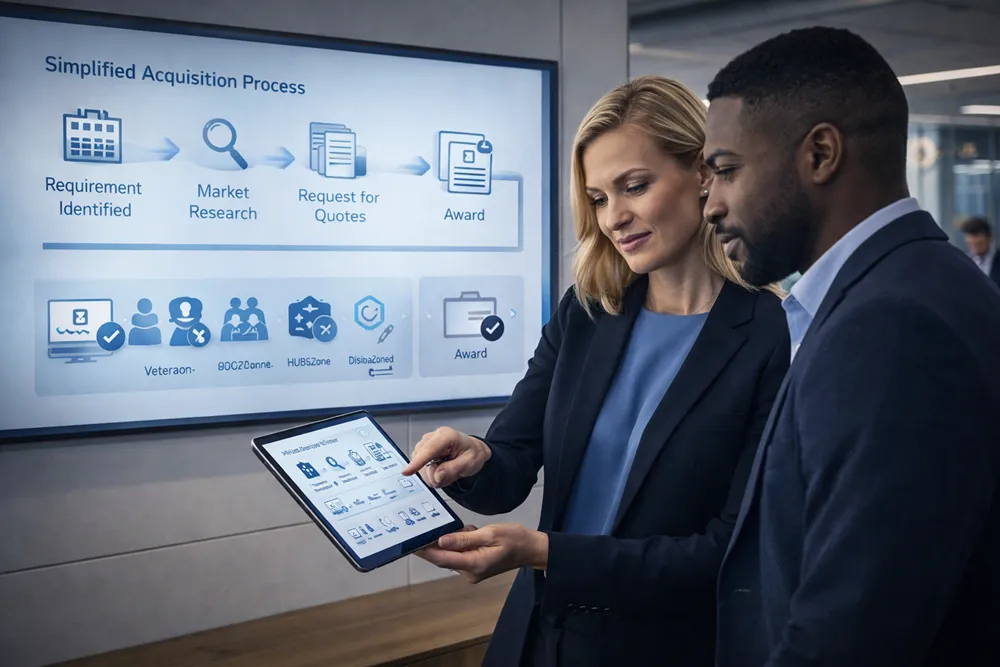
Procurement for small business through set-asides also creates opportunities at the subcontract level. Large contractors holding prime government contracts above certain thresholds are required to develop small business subcontracting plans — written commitments to award a percentage of contract spending to small businesses, including HUBZone, SDVOSB, WOSB, and small disadvantaged firms. Subcontracting under a prime contract gives small businesses the past performance and revenue they need to compete for larger prime awards — making subcontract pursuit a strategic stepping stone, not just a fallback. Our guide to simplified acquisition procedures explains how procurement thresholds and set-aside rules work together across different contract values.

Your NAICS code is the single most important search parameter in government contract discovery — and most new contractors either do not know their correct codes or use too few of them. NAICS codes are the industry classification system that federal agencies use to categorize every procurement, which means finding the right NAICS code for your products and services is the key to surfacing relevant opportunities across every platform you use. A contractor searching SAM.gov without NAICS code filtering is sifting through the entire federal marketplace manually — an impossible task when hundreds of solicitations are posted every day.
Start by identifying every NAICS code that accurately describes what your business does — most small businesses qualify under three to six codes depending on their service mix. The SBA size standards database at SBA.gov lists every NAICS code with its corresponding small business size standard (typically expressed as annual revenue or employee count), so you can confirm your small business eligibility for each code before using it in set-aside competition. Once you have your NAICS code list, save SAM.gov searches for each code — one search per NAICS code with set-aside filters applied — and set up email notifications to receive alerts when new solicitations post.
NAICS code strategy also applies to GSA schedule contracts and state procurement portals. Your GSA schedule Special Item Numbers (SINs) map to specific NAICS codes, and your eBuy alerts are organized around those SINs. State procurement portals similarly use NAICS codes or equivalent commodity codes to categorize local contracts — applying the same NAICS code discipline to state and local platforms extends your contract search coverage beyond federal without additional research overhead. For a deeper look at how the full government procurement ecosystem is organized and how to navigate it, our procurement methods guide is the essential reference.
Paid platforms accelerate government contract discovery by aggregating procurement data, procurement forecast intelligence, and competitive analysis in ways that free platforms cannot match. GovWin IQ by Deltek is the most widely used paid platform among government contractors — it tracks procurement forecast data, incumbent contract expiration dates, agency bid histories, and solicitation documents across federal and state and local government markets in a single interface. For small and mid-size contractors pursuing consistent govcon revenue, GovWin's advance visibility into upcoming RFPs is one of the highest-ROI investments available.
OryonIQ is an AI-powered platform built specifically for small businesses and govcon professionals who need intelligent government contract discovery without enterprise-tool pricing. OryonIQ matches your capabilities to relevant opportunities across federal and state and local markets using natural language search — surfacing solicitations and procurement forecast entries that fit your actual government offerings, not just your NAICS code keywords. The platform also provides agency procurement relationship mapping, helping you identify which contracting officers are active in your capability areas and which teaming partners are positioned on vehicles you want access to. For find government work without spending nights on SAM.gov, OryonIQ delivers the matching intelligence that turns scattered government procurement data into a manageable, qualified pipeline. Start finding matching government contract opportunities with OryonIQ →
Beyond opportunity discovery, paid platforms support the full government proposal cycle. Proposal tools that integrate with SAM.gov and agency databases allow small businesses to move from opportunity identification to government proposal drafting in a streamlined workflow — reducing the time between solicitation discovery and submission without sacrificing quality. Streamline your bid process by choosing a platform that covers both the discovery and response sides of federal contracting rather than stitching together separate tools for each function.

State and local government markets represent a massive, accessible opportunity for small businesses that most contractors underestimate. Local government entities — cities, counties, school districts, transit authorities, and state agencies — collectively spend hundreds of billions annually on contracts that are subject to competitive bid requirements. Unlike federal procurement, state and local contracts are posted across dozens of separate portals rather than a single system, which makes discovery more fragmented — but also means competition is often lower than on SAM.gov.
The most efficient approach to state and local opportunity discovery is to identify the two or three state procurement portals most relevant to your geography and service mix, register on each, and set up alerts for your relevant commodity codes. BidNet Direct and DemandStar aggregate local contracts from multiple state and local government entities into a single platform — reducing the number of separate portals you need to monitor. Many states also maintain centralized procurement websites (California's Cal eProcure, Texas's ESBD, Florida's MyFloridaMarketPlace) where solicitations from state and local government agencies are consolidated.
State and local government contracts are also an important subcontract source. Many local government entities lack the internal capacity to directly manage complex contracts and rely on prime contractors who hold state and local master agreements — creating subcontracting opportunities for small businesses with relevant capabilities. Find opportunities at the state and local level by attending local government procurement fairs, registering as a vendor with your city and county procurement offices, and connecting with prime contractors already holding local vehicles in your market. For the full picture of how state and local opportunities fit alongside federal pursuits, our mapping opportunities guide provides a structured pursuit playbook.

A procurement forecast is an advance notice published by a government agency listing planned contract actions — upcoming bids, RFPs, and solicitations — before they are formally released. Federal agencies are required to publish procurement forecasts annually, giving contractors visibility into what agencies plan to buy in the coming fiscal year. The procurement forecast is the most powerful early-warning tool in government contract discovery — it tells you what is coming before the RFP drops, giving you time to position, build relationships, and prepare a stronger government proposal.
Access procurement forecast data through SAM.gov's Forecast of Contracting Opportunities tool, through individual agency-specific procurement forecast portals (the Department of Defense publishes its forecast at acq.osd.mil), and through paid platforms like GovWin and OryonIQ that aggregate procurement forecast data across multiple federal agencies in a searchable interface. Filter procurement forecast entries by NAICS code, set-aside type, dollar value, and anticipated deadline to narrow the list to opportunities worth adding to your pipeline. Build a quarterly procurement forecast review into your business development calendar — the contracts you are positioning for today are the awards you will win six months from now.
Using procurement forecast data effectively means more than just noting upcoming RFPs — it means doing the pre-RFP work that positions your small business as a known, credible source before the solicitation is published. Request capability briefings with program offices, respond to any sources-sought notices that accompany procurement forecast entries, and submit capability statements to contracting officers managing upcoming procurements in your category. Small businesses that engage agencies during the procurement forecast phase consistently write stronger government proposals when the RFP drops — because they understand the agency's actual needs rather than guessing from a formal solicitation document alone. Our guide to winning government RFPs covers what happens once you move from procurement forecast to formal solicitation response.
Frequently asked questions from small businesses new to federal contracting reveal a consistent set of misunderstandings about how government contract discovery works — and answering them here directly accelerates your find government learning curve.
No. SAM.gov, USASpending.gov, SBA SubNet, and most state procurement portals are free. Registration is free on SAM.gov and is required for all federal contract awards. Paid platforms like GovWin and OryonIQ dramatically accelerate discovery and provide intelligence you cannot get for free — but free sources are a legitimate starting point for small businesses with limited budgets.
Start with SBA SubNet, where prime contractors post subcontract openings under existing federal contracts. Also reach out directly to large prime contractors in your NAICS code categories — many maintain supplier diversity programs and actively seek qualified small businesses for subcontract work. Teaming partner relationships that start as subcontract arrangements often evolve into prime contract partnerships as your past performance grows. For a full breakdown of how set-asides and subcontracting create entry points for new small businesses, read our small business set-asides guide.
A request for proposal (RFP) is a formal solicitation where federal agencies invite contractors to submit comprehensive government proposals covering technical approach, management plan, past performance, and pricing. An RFQ (request for quotation) is simpler — agencies use RFQs when the requirement is well-defined and they need only pricing and basic qualification information. RFPs are used for complex contracts; RFQs are common for GSA schedule orders and simplified acquisition purchases. Understanding the difference helps you calibrate your government proposal investment appropriately for each opportunity type. Our RFP vs RFQ vs RFI guide explains all three document types and when each appears in the government procurement cycle. Get started finding your first government contract with OryonIQ →

Are you curious about the networking events near you? Together we can expand your network and watch your pipeline exponentially grow.

Our mission is to empower the GovCon community to make better data driven decisions based on social relationships and opportunity data that is actionable, measurable, and trackable.













%20A%20Plain-English%20Guide%20for%20Contractors-sml.webp)















%20(1).webp)


