The Federal Acquisition Regulation is the rulebook for almost every dollar the U.S. government spends buying goods and services. It decides how requirements are competed, which clauses end up in your contract, how you get paid, and whether a requirement must be set aside for small business. You do not need to memorize it, but you do need to know how it is built and where to look, because the answer to most "can they do that?" questions in federal contracting is somewhere in the FAR.
Quick answer: The FAR is codified in Title 48 of the Code of Federal Regulations, maintained jointly by the Department of Defense, GSA, and NASA, and organized into 53 parts that follow the life of a contract. Agencies add their own supplements (the DoD's is the DFARS). The parts most small contractors deal with are Part 12, Part 13, Part 15, and Part 19, and the clauses live in Part 52.
The FAR is the primary set of rules governing the federal acquisition process, the uniform policies and procedures that executive-branch agencies follow when they buy. It applies governmentwide, so the same baseline rules shape a software buy at the Air Force and a janitorial contract at the Department of the Interior.
It is not a statute. The FAR implements the procurement laws Congress passes, translating them into the day-to-day procedures contracting officers actually use. And it is not static: it is revised continuously through Federal Acquisition Circulars, so a clause or threshold you relied on last year may have moved. For the short definition and how the term fits the wider vocabulary, see our glossary entry on the Federal Acquisition Regulation.
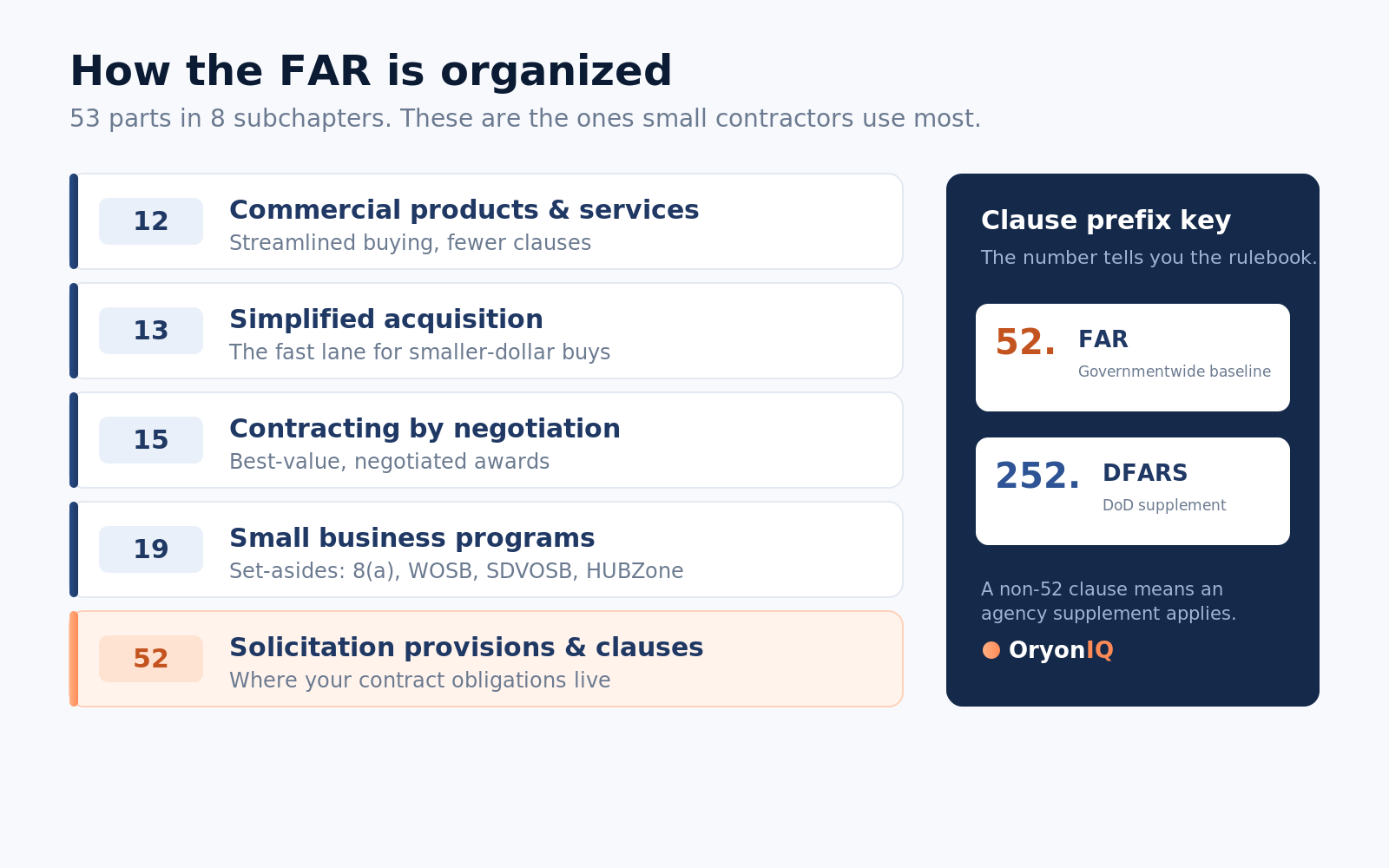
The regulation is divided into 53 parts, grouped into subchapters that roughly track the life of a contract: general matters, acquisition planning, competition and contractor qualifications, types of contracts, special categories of contracting, contract management, and the clauses themselves. You navigate it by part, then subpart, then section, so a citation like FAR 19.502 points to Part 19, subpart 5, section 02.
You will rarely read the FAR cover to cover. In practice you learn the handful of parts that govern the work you pursue and look up the rest when a solicitation cites it.
When people say a contract is "FAR-based," they mostly mean its clauses. Part 52 contains the standard clauses and provisions, and a clause number beginning with 52 is a FAR clause. These are the enforceable terms: how you invoice, your rights if the government changes the work, termination, inspection and acceptance, small-business representations, and dozens more.
Two practical habits separate contractors who manage risk from those who get surprised:
The FAR sets the governmentwide baseline, and individual agencies layer their own rules on top through supplements. The big one is the Department of Defense's DFARS, the Defense Federal Acquisition Regulation Supplement, whose clauses begin with 252 and cover defense-specific requirements like supply-chain rules and safeguarding sensitive information. Other departments such as DHS and NASA publish their own supplements with their own numbering.
The tell is the clause prefix. A 52-series clause is FAR; a 252-series clause is DFARS; other prefixes point to other supplements. When you see a non-52 clause in a solicitation, that is your cue that an agency-specific requirement applies, and you need to read it before you commit.
You do not need the whole regulation to bid well, you need to read the solicitation the way an evaluator does. A negotiated solicitation is usually organized in uniform sections, and three matter most: the description of the work, the instructions for how to submit (often Section L), and the evaluation factors (often Section M). The FAR is what stands behind those sections. Knowing, for example, that the work is being bought under Part 12 as commercial, set aside under Part 19, and evaluated under Part 15 tells you how competitive it will be and exactly how to shape your response.
The FAR is large, it changes, and the consequences of missing a clause are real. Ask Oryon, OryonIQ's built-in AI assistant, answers FAR and clause questions in plain language and cites its sources, so you can check what a clause means without disappearing into Title 48. And because the FAR is revised continuously, OryonIQ's Insights module flags the regulatory and policy changes that affect your bids before they catch you off guard.
Create a free OryonIQ account and put a FAR-literate assistant and policy alerts to work for your business.
The FAR is the main rulebook for how U.S. federal agencies buy goods and services. It is found in Title 48 of the Code of Federal Regulations, applies to almost every executive-branch agency, and governs everything from competition to contract clauses to small-business set-asides.
It is maintained jointly by three agencies, the Department of Defense, the General Services Administration, and NASA, and updated continuously through Federal Acquisition Circulars.
The FAR has 53 parts, grouped into subchapters that follow the life of a contract, from acquisition planning through contract management and the standard clauses in Part 52.
The FAR is the governmentwide baseline. The DFARS is the Department of Defense's supplement that adds defense-specific rules on top. FAR clauses begin with 52; DFARS clauses begin with 252, and you comply with both on a defense contract.
Most often Part 12 (commercial items), Part 13 (simplified acquisition), Part 15 (negotiated procurement), and Part 19 (small business programs), with contract types defined in Part 16 and clauses in Part 52.

Are you curious about the networking events near you? Together we can expand your network and watch your pipeline exponentially grow.

Our mission is to empower the GovCon community to make better data driven decisions based on social relationships and opportunity data that is actionable, measurable, and trackable.




.webp)


.webp)